If you want the strongest cooling option in 2025, an air conditioner keeps you cooler than an air cooler. Air conditioners lower the temperature much more, especially in hot and humid areas. You might wonder which is better for your needs. If you compare air cooler vs ac, you see that air conditioners win for cooling power. Still, you may ask which is better for your budget, energy use, or local climate. Check the quick table below to see which is better for you.
Air conditioners cool rooms faster and make them colder. They work well in big or humid rooms.
Air coolers use less electricity and are cheaper to buy. They also cost less to run. This helps you save money and energy.
Air coolers work best in dry places with good airflow. Air conditioners work well in any weather and in closed rooms.
Both devices need regular care to work well. Air coolers are easier and cheaper to take care of.
New 2025 models have smart features. These features help save energy and make you more comfortable.
Air conditioners take water out of the air. This helps in wet places. Air coolers add water to the air, which is good for dry places.
You should pick the right device for your weather, room size, budget, and comfort.
Easy habits like using curtains, closing leaks, and cleaning filters help you save money. They also make your cooling work better.
When you compare air cooler vs ac, you notice a big difference in cooling power. An air conditioner can cool your room to any temperature you set, often reaching 18–22°C even on the hottest days. This makes it the best choice if you want strong, fast cooling. Air coolers work differently. They use water to cool the air, which lowers the temperature by about 10–15°C in dry climates. However, air coolers do not work as well in humid weather. You may feel a gentle breeze, but the room will not get as cold as with an air conditioner. If you live in a place with high humidity, an air conditioner will always keep you cooler.
Tip: Air conditioners provide consistent cooling in all climates, while air coolers work best in dry heat.
Energy use is another important part of the air cooler vs ac debate. Air coolers use much less electricity than air conditioners. Most air coolers run on 50–300 watts, which means you save money on your power bill. Air conditioners, on the other hand, need 1,000–1,800 watts for a typical home unit. This higher energy use gives you stronger cooling, but it also means higher costs. If you want to save energy and care about efficiency, an air cooler is the better choice. You will notice the difference in your monthly bills, especially if you use your cooling device every day.
Here is a quick comparison table:
Feature | Air Cooler | Air Conditioner |
|---|---|---|
Cooling Power | Moderate, best in dry climates | Strong, works in all climates |
Energy Use | 50–300 watts | 1,000–1,800 watts |
Efficiency | High | Lower |
Cost matters when you choose between an air cooler and an air conditioner. Air coolers cost much less to buy and to run. You can find a good air cooler for $150–$400. Even a whole-house air cooler usually costs less than $2,500. The operating cost stays low, often just $15–$30 extra per month on your electricity bill. Maintenance is simple and cheap, usually under $100 per year.
Air conditioners cost more upfront. A window unit may cost $200–$800, while a central air conditioner can cost $3,000–$7,500 or more. You also pay more each month to run it, with bills that can reach $100–$200 or higher. Maintenance for air conditioners is more expensive, too, often $100–$400 per year.
If you want the lowest cost and best efficiency, an air cooler is the winner. If you need the strongest cooling, an air conditioner is worth the higher price.
Picking between an air cooler and an air conditioner depends on where you live. You need to choose what works best for your weather and your home. The air cooler vs ac question is about how each one deals with heat and humidity.
Here is a simple table to help you match your climate:
Climate/Condition | Best Choice | Why It Works Best |
|---|---|---|
Dry, Arid Climates | Air Cooler | Uses evaporative cooling, which works well in low humidity. |
Humid, Coastal Climates | Air Conditioner | Removes moisture from the air, making rooms feel cooler and less sticky. |
Moderate/Coastal | Both | Either can work, but air conditioners give more steady cooling. |
Semi-open/Natural Ventilation | Air Cooler | Performs better with good air flow and open windows. |
Enclosed, Insulated Rooms | Air Conditioner | Controls temperature and air quality in closed spaces. |
If you live in a dry place, like a desert, use an air cooler. It works well because there is not much water in the air. Air coolers are also good for patios or rooms with many windows. Fresh air helps them cool better.
If you live where it is humid, an air conditioner is better. It takes water out of the air, so you feel less sweaty. Air conditioners work best in closed rooms where you want steady cooling.
Tip: For bedrooms or offices, pick an air conditioner for better control. For outside or open rooms, an air cooler gives a nice breeze.
When you look at air cooler vs ac, always think about your weather and your space. This helps you stay comfortable and get the best value.
You want a cooling device that is easy to take care of. Maintenance helps your air cooler or air conditioner last longer and work well.
Air Coolers:
Air coolers are easy to keep clean. Wash the water tank every week to stop germs. Change or rinse the pads once a month if you use it a lot. Check the fan and vents for dust. Most people can do this at home with simple tools. You will spend less time and money fixing it.
Air Conditioners:
Air conditioners need more care. Clean or change the filters every month. Clean the coils and fins once a year. Sometimes, you need a pro to check the parts inside. This keeps the air cool and clean. It costs more to keep up, but it stops big problems and keeps it working well.
Note: Taking care of both systems helps them last longer and work better. If you want less work, an air cooler is easier.
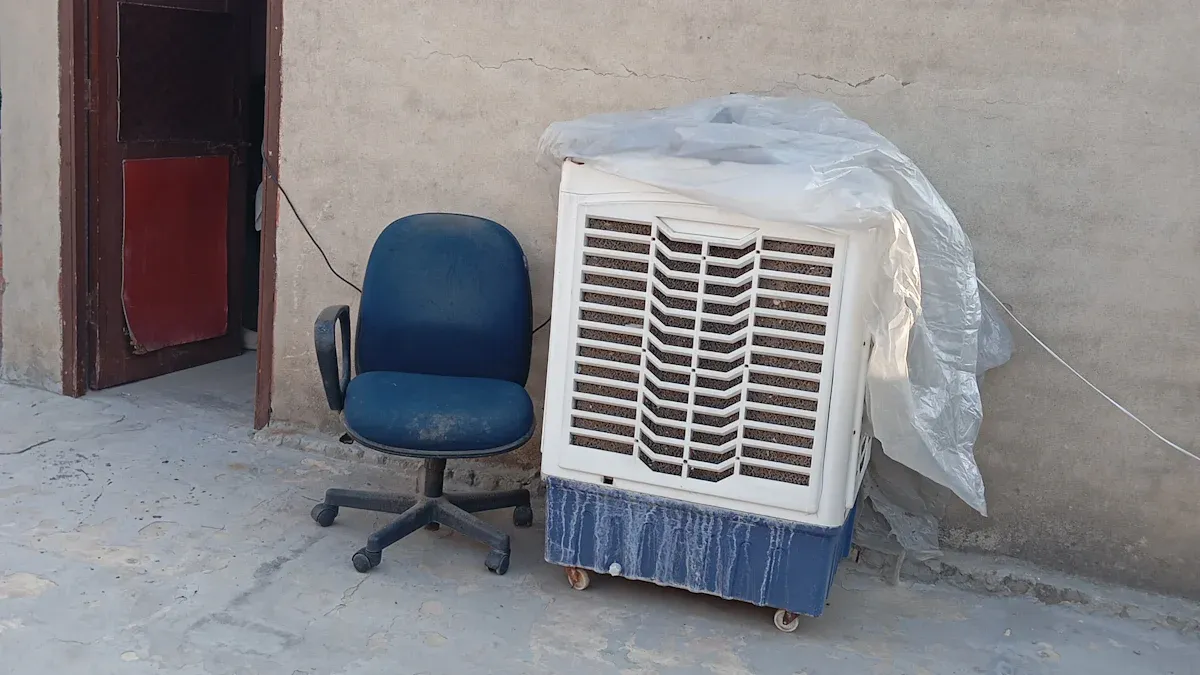
You may wonder how an air cooler cools your room. An evaporative cooler pulls warm air through wet pads. The water in the pads turns into vapor as air moves through. This takes heat from the air and makes it cooler. The cool air then goes back into your room. This method does not use chemical refrigerants or compressors. It uses evaporation, which is a natural process. This makes air coolers energy-efficient and good for the environment.
There are a few types of evaporative coolers. Direct coolers add moisture to the air, so they work best in dry places. Indirect coolers cool the air but do not add much humidity. These are good for areas with some moisture. Two-stage coolers use both ways to work better in more climates. But air coolers have some limits. They work best in dry or a little humid places. If you live where it is very humid, you may not feel much cooling. You also need to keep windows or doors open for fresh air. Clean the pads and water tank often to keep your air cooler working well.
Tip: An evaporative cooler is a smart pick if you want to save energy and live in a dry place.
An air conditioner cools your room in a different way. It uses a vapor compression cycle. First, it pulls warm air over cold coils with refrigerant inside. The refrigerant takes heat from the air and turns into a gas. The cool air goes back into your room. The refrigerant gas moves to the outside unit. There, it gets squeezed and lets out heat. Then, the refrigerant cools down and goes back inside to start again.
Air conditioners in 2025 have new features. Some use liquid desiccant to remove humidity better. This helps you feel cooler and saves energy. Many air conditioners have smart controls and sensors. These adjust cooling for your needs. These systems work well in all climates, even in humid or tightly closed rooms.
Air conditioning gives you strong, steady cooling and controls both temperature and humidity.
You can see the main difference in how each device cools the air. Here is a quick table to help you compare:
Parameter | Air Coolers | Air Conditioners |
|---|---|---|
Cooling Method | Uses natural water-based evaporation to cool air | Uses chemical refrigerants and compressors to cool air |
Energy Efficiency | Consumes significantly more energy | |
Installation & Portability | Portable and easy to install | Requires professional installation; fixed units |
Environmental Impact | Eco-friendly with a lower environmental footprint | Emits greenhouse gases and has a higher environmental impact |
Cost Factor | More affordable in initial purchase and long-term use | Higher initial and operational costs |
In 2025, both air coolers and air conditioners have smart features. Air coolers now have smart controls, adaptive cooling, and remote checks. Some even use AI to save energy and work better. Air conditioners have advanced inverter systems and better refrigerants. They also have stronger heat pumps for tough weather. Both devices use IoT and AI for easy maintenance and energy tracking.
Air coolers focus on saving energy and eco-friendly cooling, especially in dry places.
Air conditioners give strong, steady cooling for big rooms and comfort all year.
When you look at the difference between air cooler and air conditioner, think about your weather, room size, and how much control you want over temperature and humidity.
You might wonder how well these devices cool your room. In 2025, new direct evaporative coolers use special pads made from Enset fiber. These pads help cool the air better and save energy. Tests show a three-stage air cooler can lower the temperature by 6.8°C. It also makes the air more humid by 33.5%. The cooling power is 17.6 W/m², and it works up to 65% as well as top systems. If you turn up the fan, the room gets even cooler. These coolers use less electricity and are better for the planet. But you need to clean and check them often.
Air conditioners have also changed a lot in 2025. Some new models use three ways to cool: radiative sky cooling, evaporative cooling, and air cooling. This mix cuts power use by almost 20%. It also lowers the total cost by over 12%. You get stronger cooling and better energy savings. Some air conditioners now have a special coating. This coating can drop the inside temperature by up to 11.4°C. It also keeps the outside part cooler all day and night. These new features give you more cooling power and steady comfort, even when it is very hot.
If you want the strongest and most steady cooling, new air conditioners are the best in 2025.
Humidity and climate really change how well these coolers work. Here is what you should know:
Air coolers add water to the air. In dry places, this cools you down a lot. In humid places, it can make you feel hotter and sticky.
Air conditioners take water out of the air. This helps you feel cooler, even if it is muggy outside.
If you live where it is very humid, air conditioners give you better and more steady cooling.
In dry places, air coolers work well. But in humid cities like Pittsburgh, they can make rooms damp and uncomfortable.
You should always pick a cooler that fits your local weather for the best results.
In 2025, both air coolers and air conditioners get new upgrades. The table below shows the main changes:
Aspect | Details |
|---|---|
Regulatory Change | All new air conditioners must use refrigerants with a Global Warming Potential (GWP) ≤ 750 |
Old vs New Refrigerants | Old types had GWP of 1,800–2,200; new ones like R32 and R454B are much lower |
Notable Refrigerant | R454B, used in many new models, meets rules for the next decade |
Technology Impact | New sensors track refrigerant use; new installation steps needed |
Cost Impact | Prices rise due to new tools and longer installation times |
Performance Impact | No loss in cooling performance or efficiency |
Consumer Advice | Buying before 2025 may save money due to lower prices and easier installation |
You will see more eco-friendly refrigerants and smarter sensors in new air conditioners. LG and other brands are working to meet new EPA rules. These changes help the earth but may make prices go up. The good news is you still get the same strong and steady cooling with these new updates.
You want your room to feel cool and comfortable, no matter the weather outside. Air conditioners and air coolers handle temperature and humidity in different ways. Air conditioners use chemical refrigerants to lower the temperature quickly. You can set the exact temperature you want, and the AC keeps it steady. Many air conditioners in 2025 also have special modes for humid days. These modes remove extra moisture from the air, so you do not feel sticky or sweaty.
Air coolers work by pulling warm air through wet pads. This process cools the air, but it works best in dry climates. If the air is already humid, the cooler cannot lower the temperature much. You may notice the room feels damp instead of cool. Air coolers also add moisture to the air, which can be helpful in dry places but not in humid ones.
Here is a quick table to help you compare:
Feature | Air Cooler | Air Conditioner |
|---|---|---|
Temperature Control | Slower, less deep cooling; best in dry climates | Fast, consistent cooling; works in all climates |
Humidity Control | Adds moisture; not effective in humid conditions | Removes moisture; keeps air dry and comfortable |
If you want fast, steady cooling and good humidity control, an air conditioner gives you the best comfort.
Noise can affect your comfort and sleep. Air coolers usually make a gentle fan sound. Some people find this white noise relaxing. You may hear water trickling as the cooler runs, but it is not very loud. Most air coolers are quiet enough for bedrooms or study rooms.
Air conditioners can be a bit louder, especially older models or window units. You might hear the compressor start and stop. Newer ACs in 2025 use better technology to reduce noise. Many split ACs and inverter models run quietly, so you can sleep or work without distraction.
Tip: If you are sensitive to noise, look for models with a "quiet" or "sleep" mode for a better cooling experience.
Air freshness matters for your health and comfort. Air coolers pull in fresh air from outside through wet pads. This brings new air into your room, which can feel refreshing. You need to keep a window or door open for the cooler to work well. However, this can also let in dust, pollen, or outdoor pollution. If you live in a city or near smoke, this may lower your indoor air quality.
Air conditioners use a closed system. They recirculate the air inside your room and filter out dust and allergens. This keeps the air clean and dry. You do not need to open windows, so you avoid outdoor pollutants. Some new ACs have advanced filters that trap even tiny particles.
Air coolers bring in fresh air but may allow outdoor dust and pollen.
Air conditioners filter indoor air and keep it clean, but do not bring in outside air.
In dry, clean areas, air coolers can improve freshness. In polluted or humid places, air conditioners offer better air quality and comfort.
Note: If you have allergies or live in a dusty area, an air conditioner may give you a healthier cooling option.
Choosing the right cooling solution depends on the size of your room. If you have a small bedroom or office, a cooler can work well. It gives you a gentle breeze and lowers the temperature in spaces up to 150 square feet. For medium rooms, you may need a larger cooler or a small air conditioner. When you want to cool a big living room or an entire apartment, an air conditioner is the better choice. It can handle large spaces and keeps the temperature steady.
Here is a quick guide:
Room Size | Best Option | Why It Works |
|---|---|---|
Small (up to 150 sq ft) | Cooler | Easy to move, uses less energy |
Medium (150–300 sq ft) | Cooler or AC | Both can work, depends on climate |
Large (over 300 sq ft) | Air Conditioner | Strong cooling, covers big areas |
Tip: Measure your room before you buy. This helps you pick the right size and type for your needs.
The way you use your space also affects your choice in the cooler vs ac debate. Air coolers work best in open or semi-open spaces. You need to keep a window or door open for fresh air. This lets the cooler push out warm air and bring in cool air. If you use a cooler in a closed room, the air can get too humid and less comfortable.
Air conditioners work best in closed spaces. You should keep windows and doors shut. This helps the air conditioner control the temperature and humidity. It also keeps dust and pollen outside. If you want to cool a sealed bedroom, office, or living room, an air conditioner is the best cooling solution.
Use a cooler for patios, balconies, or rooms with lots of airflow.
Use an air conditioner for bedrooms, offices, or any space you want to keep sealed.
Climate plays a big role in the cooler vs ac decision. In dry climates, you get the best results from a cooler. The air is dry, so the cooler adds moisture and drops the temperature. Studies show that traditional cooling devices like courtyards and wind towers work well in hot-dry places. These methods, along with modern coolers, improve comfort and save energy. You can also use shading devices, light-colored walls, and natural airflow to boost cooling.
In humid climates, an air conditioner is the top choice. Humid air holds more water, so a cooler will not work as well. You may feel sticky instead of cool. Air conditioners remove moisture from the air, making your room feel dry and comfortable. Experts in 2025 recommend using shading, humidity control devices, and natural ventilation in humid areas. Devices like overhangs, louvres, and breathable materials help, but an air conditioner gives you the most reliable cooling solution.
Note: If you live in a dry place, try passive cooling methods like shading and natural airflow with your cooler. In humid areas, focus on humidity control and use an air conditioner for the best results.
When you compare air coolers and air conditioners, you see a big difference in energy consumption. Air coolers use much less electricity. Most air coolers in 2025 run on only 80 to 150 watts. This makes them very energy-efficient and perfect for anyone on a tight budget. Some new models even work with inverters, which helps you save more energy.
Air conditioners, on the other hand, use much more power. A 1-ton air conditioner uses about 0.8 to 1.2 kWh per hour. A 1.5-ton unit can use 1.5 to 2 kWh per hour. This means air conditioners can use up to 10 times more electricity than air coolers. If you run your AC for many hours each day, your energy bills will go up fast.
Appliance | Power Consumption (Watts/kWh) | Notes |
|---|---|---|
Air Cooler | 80 to 150 watts | Depends on size and capacity |
1-ton Air Conditioner | 0.8 to 1.2 kWh per hour | Energy use varies by EER and inverter tech |
1.5-ton Air Conditioner | 1.5 to 2 kWh per hour | Higher consumption due to larger capacity |
You get the best energy efficiency with air coolers. If you want to lower your energy consumption and keep your budget in check, air coolers are the top choice.
You need to think about both the price you pay at the store and the money you spend each month. Air coolers cost less to buy. Most models fit easily into a small budget. You also spend less on running costs because they use less electricity. Maintenance is simple and cheap, which adds to their cost-effectiveness.
Air conditioners cost more upfront. You pay more for installation and for the unit itself. The running costs are higher because of the extra power they use. You also need to pay for regular maintenance to keep the system working well. If you want strong cooling and do not mind a bigger investment, an air conditioner gives you that comfort.
Tip: Always check the energy efficiency rating before you buy. High-efficiency models save you money over time.
You can lower your cooling bills with a few smart habits. Try these tips to boost efficiency and protect your budget:
Use blackout curtains or blinds to block heat during the hottest part of the day.
Open windows at night to let in cool air, then close them in the morning.
Run ceiling fans counterclockwise to push cool air down and let you set the thermostat higher.
Seal cracks and leaks around windows and doors to stop cool air from escaping.
Clean or replace air filters often to keep airflow strong and energy use low.
Upgrade to energy-efficient appliances and use smart thermostats to control cooling schedules.
Schedule regular maintenance for your AC to keep it running at peak efficiency.
Limit heat-producing activities, like cooking, during peak hours.
Note: Small changes in your daily routine can make a big difference in your running costs and energy efficiency.
You want your air cooler to work well and last longer. Regular cleaning and upkeep help you get the best cooling and keep the air fresh. If you use your air cooler often, you should follow a simple routine.
Weekly Tasks:
Drain the water reservoir completely. This step stops mold from growing inside your air cooler. Run the fan without water to dry the filter pads. Check the water level every day if you use the cooler a lot.
Monthly Tasks:
Remove the filter pads and clean them with a mix of vinegar and water. This solution disinfects and removes odors. Wash the water reservoir and filter compartment with soap and water. Let the pads dry before putting them back.
Bi-monthly or Quarterly Tasks:
Take off any winter covers or insulation. Replace cooler pads if you see damage. Clean away mineral deposits, like calcium, using a white vinegar solution. If you notice rust in the reservoir, repaint it. Inspect the float valve and water supply for leaks. Check the motor, fan belt, and bearings. Lubricate the motor parts and tighten the belt if needed. Run the air cooler to make sure the pads stay wet and the cooling feels right.
You should also clean the air filters every month to stop dust from building up. Schedule a professional service every six months for a deep check. If you hear strange noises or see water leaking, inspect the parts right away. A foul smell means you need to drain and disinfect the tank and pads.
Tip: Keep your air cooler in the shade. This reduces strain and helps it cool better.
You help the environment when you choose an air cooler. This device uses natural evaporation to cool the air. It does not use chemical refrigerants, so it does not release harmful gases. Air coolers use much less electricity than air conditioners. This means you lower your carbon footprint and save energy.
Most air coolers use water as the main cooling agent. You can use fresh water, and some models even recycle water to reduce waste. Because air coolers do not need complex parts, they are easier to recycle at the end of their life. You also avoid the risk of refrigerant leaks, which can harm the ozone layer.
Note: If you want a cooling solution that is gentle on the planet, an air cooler is a smart choice. You get comfort and help protect the environment at the same time.
If you want your room to be the coldest, pick an air conditioner. In 2025, tests show window air conditioners cool a room by 10°F in just 15 minutes. Portable air conditioners take more time and do not cool as much. Air coolers cannot cool a room this fast or this much. They add water to the air, which helps in dry places. But they do not lower the temperature as much as air conditioners.
Here is a table that shows how well different air conditioning devices cool in 2025:
Feature/Metric | Window Air Conditioner (2025) | Portable Air Conditioner (2025) |
|---|---|---|
Cooling Speed | Lowers room temperature by 10°F in 15 minutes | Takes over 20 minutes to reduce temperature by 5°F |
BTU Rating Consistency | Maintains BTU rating under 2025 SACC standards | Shows ~30% reduction in actual cooling capacity compared to ASHRAE ratings |
Energy Efficiency Ratio (EER) | 10-12+ | 8-10 (best models 10+) |
Cooling Area Coverage (8000 BTU) | 350-400 sq ft | 300-350 sq ft |
Runtime Efficiency | Maintains set temperature with 50% less runtime | May run continuously in extreme heat without reaching desired temperature |
You can see window air conditioners give the strongest cooling. They keep your room at the temperature you want, even when it is very hot outside. Air coolers cannot cool as quickly or as much, especially if it is humid. If you want the most cooling, an air conditioner is the best choice.
Tip: For bedrooms or living rooms, use a window air conditioner if you want strong and steady cooling.
If saving energy is most important to you, look at air coolers. These use much less electricity than air conditioners. Most air coolers only need 80 to 150 watts to run. You can use them for a long time without a big power bill. Air conditioners, even the best ones, use a lot more energy. A 1-ton air conditioner can use up to 1.2 kWh every hour.
Studies in 2025 show air coolers help save energy in hot, dry places. Data centers using these coolers use less power and save more energy. How well these coolers work depends on the weather and the way they are built. In the right place, you can save a lot of money on energy.
If you want to know which saves more energy, air coolers are the best. They keep you comfortable and help you save money each month.
Note: Use an air cooler if you want to keep your energy bills low and still have a cool room.
You should think about your local weather before picking a cooling device. Air coolers work best in hot, dry places. They add water to the air and make you feel cooler. In humid places, air coolers do not work as well. The air already has a lot of water, so the cooler cannot lower the temperature much.
Air conditioners work in all types of weather. They take water out of the air, so you feel cooler even when it is sticky outside. If you live near the ocean or in a humid place, an air conditioner is better. It gives you steady cooling and keeps the air dry.
Studies in 2025 show air coolers save energy in hot, dry places. These coolers work best when the air is not humid. In other places, air conditioners work better.
Here is a quick guide:
Dry, hot climate: Pick an air cooler for energy savings and comfort.
Humid or coastal climate: Pick an air conditioner for strong cooling and dry air.
Mixed or changing climate: Air conditioners give you more control and steady results.
Tip: Always choose your cooling device based on your local weather for the best comfort and savings.
Choosing between an air cooler and an air conditioner in 2025 can feel confusing. You want to make the right choice for your comfort, budget, and health. Use this checklist to guide your decision:
Factor | Air Cooler (Evaporative) | Air Conditioner (Portable/Window) |
|---|---|---|
Best for Dry Climates | ✅ Yes | ✅ Yes |
Best for Humid Climates | ❌ No | ✅ Yes |
Small Room Suitability | ✅ Yes | ✅ Yes |
Large Room Suitability | ✅ (Large models) | ✅ Yes |
Personal Space Cooling | ✅ Yes | ❌ No |
Quiet Operation | ✅ Yes | ❌ (Some models) |
Allergy-Friendly | ✅ Yes | ✅ (with filters) |
Low Maintenance | ✅ Yes | ❌ No |
No Chemical Refrigerants | ✅ Yes | ❌ No |
Fast, Deep Cooling | ❌ No | ✅ Yes |
Energy Efficiency | ✅ Yes | ❌ No |
Budget-Friendly | ✅ Yes | ❌ No |
Tip: If you live in a dry area and want to save energy, an air cooler works well. If you need strong cooling in a humid place, choose an air conditioner.
Ask yourself these questions before you buy:
Do you live in a dry or humid climate?
How big is the room you want to cool?
Do you need quiet for sleep or study?
Are you sensitive to dust or allergies?
Do you want to avoid chemical refrigerants?
Is energy savings your top priority?
Do you need fast, powerful cooling?
Quick Steps to Decide:
Check your local climate.
Dry = Air cooler
Humid = Air conditioner
Measure your room size.
Small = Either device
Large = Air conditioner or large air cooler
Think about your health and comfort.
Allergies or need for quiet = Air cooler or AC with good filters
Set your budget.
Tight budget = Air cooler
Willing to invest for comfort = Air conditioner
Remember: The best choice depends on your needs, your space, and your local weather. Use this checklist to find the cooling solution that fits your life in 2025.
You get the coolest results in 2025 with an air conditioner, especially in humid or large spaces. If you want to save energy or have a tight budget, an air cooler works well in dry climates. Think about your room size, local weather, and comfort needs. Use the decision checklist to match your situation with the best cooling option. Make your choice based on what matters most to you.
You get cooling from an air cooler by adding moisture to the air. An air conditioner removes heat and moisture from the air. Air conditioners work better in humid places. Air coolers work best in dry climates.
You should not use an air cooler in a closed room. Air coolers need fresh air to work well. Open a window or door to let air flow. This helps the cooler lower the temperature.
Yes, most air conditioners have filters that trap dust and pollen. Some models use advanced filters for better air quality. You should clean or replace the filters often for the best results.
Air coolers use about 3 to 10 liters of water per hour. The amount depends on the size of the cooler and the humidity in your area. You need to refill the water tank often during hot days.
Air coolers cost much less to run than air conditioners. You use less electricity with an air cooler. Your monthly bills stay lower. Air conditioners use more power and cost more each month.
You should not use both at the same time in the same room. Air coolers add moisture, while air conditioners remove it. Using both can make each device work less efficiently.
Clean or replace the filter every month. Wipe the coils and vents. Schedule a yearly check-up with a technician. This keeps your air conditioner running well and helps you avoid costly repairs.
Air coolers can help if you use clean water and keep the pads clean. They do not filter dust as well as air conditioners. If you have allergies, choose a cooler with a dust filter or use an air conditioner with HEPA filters.


