When you ask how much does it cost to run a portable air conditioner, you can expect a wide range. For most people in the United States, the average cost per hour falls between $0.06 and $0.88, depending on unit size and efficiency. The average cost per month can range from $15 to $200. For example, a typical 8,000 BTU unit might cost $0.20–$0.30 per hour and about $75 monthly if used 10 hours a day.
| Usage Period | Electricity Consumption | Cost per kWh | Estimated Cost (USD) |
|---|---|---|---|
| Hourly | ~0.016 kWh (8000 BTU AC) | $0.16 | $0.20 - $0.30 |
| Daily (10 hrs) | ~0.16 kWh x 10 hrs | $0.16 | ~$3.00 |
| Monthly (300 hrs) | ~0.16 kWh x 300 hrs | $0.16 | ~$75.00 |
When you want to know how much does it cost to run ac for different sizes and usage, check the chart below for a quick view of the cost to run a portable air conditioner each month:
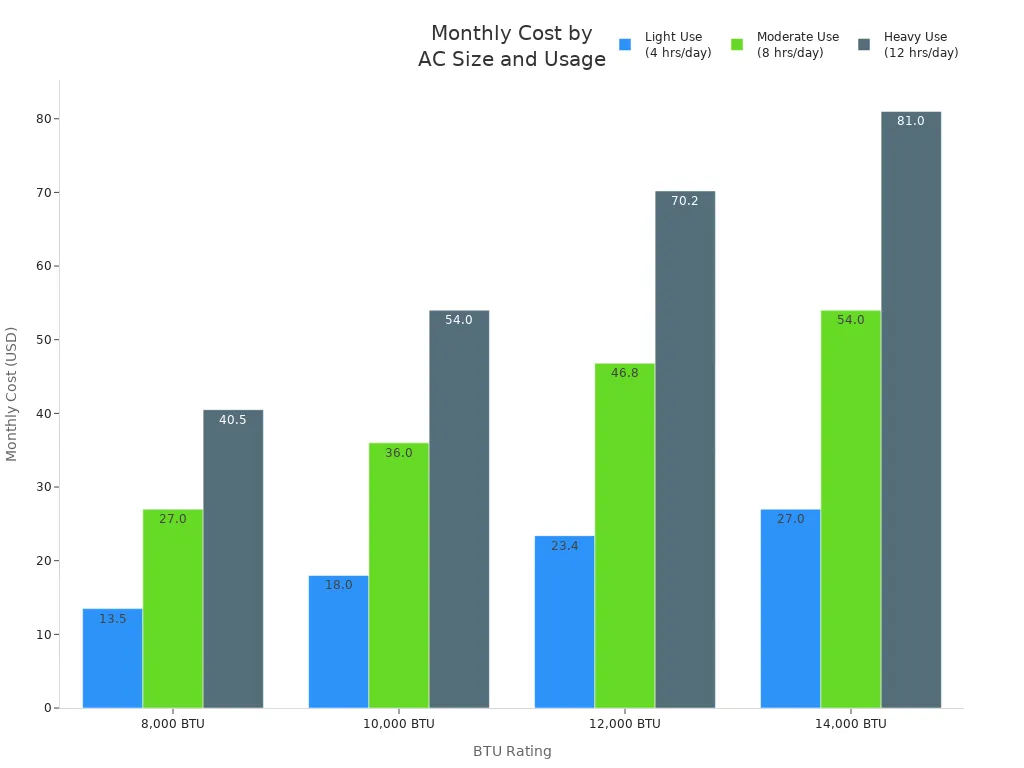
The cost to use a portable air conditioner can change a lot. It usually costs between $0.06 and $0.88 each hour. Each month, it can cost from $15 to $200. The price depends on the size, how much you use it, and your electricity rates.
You can find out your cost by using a simple formula. Multiply your AC’s wattage (in kilowatts) by the hours you use it. Then, multiply that by your local electricity rate per kWh.
Picking the right AC size for your room helps save energy and money. Bigger units use more power but can cool bigger rooms.
Energy efficiency ratings like EER and CEER are important. They help you find units that use less electricity and lower your bills.
Your local electricity rates matter a lot. How long you run your AC each day also changes your monthly cost.
Portable ACs cost more to use than window units. But they are easy to move and simple to install.
You can save energy and money by using timers and setting the best temperature. Using fans with your AC also helps lower energy use.
Cleaning filters and sealing air leaks is important. This regular maintenance makes your AC work better and keeps costs down.
When you want to know how much does it cost to run a portable air conditioner, you need to look at the size of your unit, how long you use it, and your local electricity rate. Most people in the US use an average electricity rate of about $0.107 per kWh, but some areas use $0.16 per kWh or even higher. These rates help you estimate the cost to run an air conditioner in your home.
Let’s break down the cost to run an air conditioner for three common portable AC sizes. You can use these examples to estimate your own costs.
First, convert the wattage to kilowatt-hours: 900W ÷ 1000 = 0.9 kWh.
Next, multiply by the electricity rate: 0.9 kWh × $0.19 = $0.17 per hour.
If you use the AC for 8 hours, the daily cost is $0.17 × 8 = $1.36.
For a month (30 days), the cost is $1.36 × 30 = $40.80.
Convert wattage: 1,200W ÷ 1000 = 1.2 kWh.
Multiply by the rate: 1.2 kWh × $0.19 = $0.23 per hour.
Daily cost for 8 hours: $0.23 × 8 = $1.84.
Monthly cost: $1.84 × 30 = $55.20.
Convert wattage: 1,500W ÷ 1000 = 1.5 kWh.
Multiply by the rate: 1.5 kWh × $0.19 = $0.29 per hour.
Daily cost for 8 hours: $0.29 × 8 = $2.32.
Monthly cost: $2.32 × 30 = $69.60.
Note: The cost to run an air conditioner can change if you use it more or less each day. The average cost per month depends on your usage pattern.
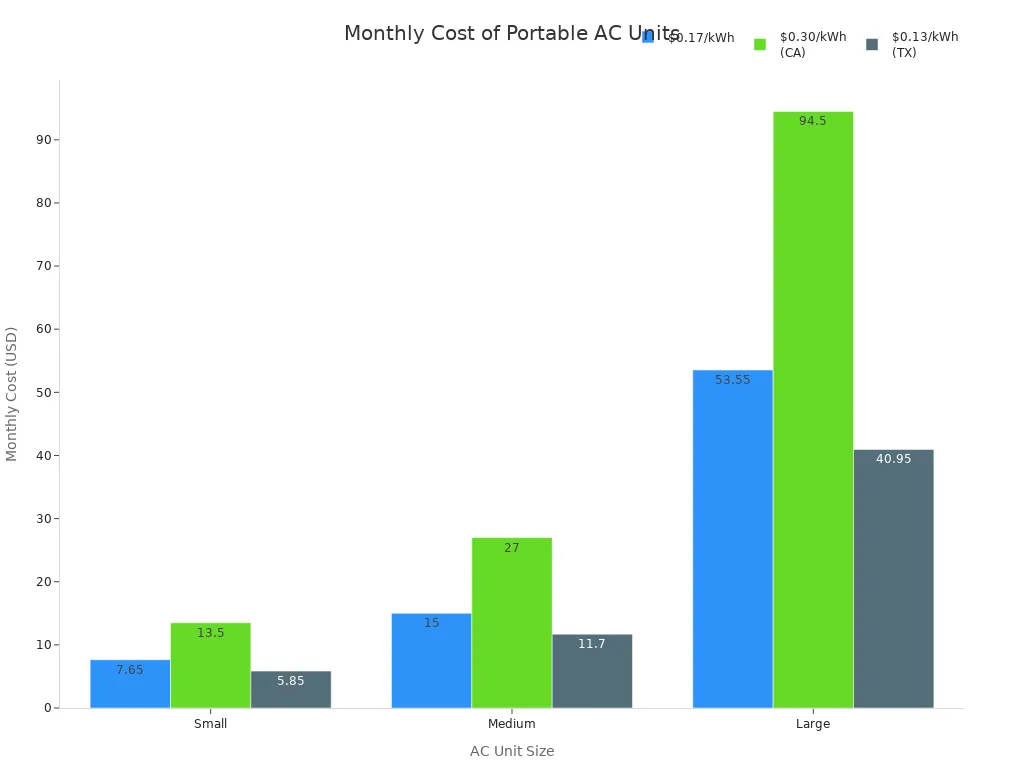
You can see how much does it cost to run a portable air conditioner at different electricity rates and sizes in the table below. This table uses 6 hours of daily use, which is common for many homes.
| AC Unit Size | Power (Watts) | Daily Energy Use (kWh) | Monthly Energy Use (kWh) | Monthly Cost at $0.17/kWh | Monthly Cost at $0.30/kWh | Monthly Cost at $0.13/kWh |
|---|---|---|---|---|---|---|
| Small | ~500 | 1.5 | 45 | $7.65 | $13.50 | $5.85 |
| Medium | 1,000-1,500 | 3 | 90 | $15.00 | $27.00 | $11.70 |
| Large | ~3,500 | 10.5 | 315 | $53.55 | $94.50 | $40.95 |
Seasonal changes affect the cost to run an air conditioner:
Costs rise in summer because you use your AC more.
Hotter regions have higher costs and energy consumption.
Efficient models lower your monthly operating costs.
Good maintenance helps reduce long-term expenses.
When you ask how much does it cost to run a portable air conditioner, remember that the cost can range from $0.06 to $0.88 per hour. The average cost per month is usually between $15 and $200, depending on your electricity usage and energy consumption. If you live in a hot area or use your AC for many hours, your monthly cost of running a portable air conditioner will be higher. Always check your local electricity rate and your unit’s energy consumption to get the most accurate answer.
If you want to know how much electricity does a portable AC use and how much it will cost you, you can use a simple formula. This formula helps you calculate the cost of running a portable air conditioner for any size or usage pattern.
To calculate the cost of running a portable air conditioner, follow these steps:
Find the wattage of your unit or convert BTUs to watts (BTU × 0.293).
Convert watts to kilowatts by dividing by 1,000.
Multiply kilowatts by the number of hours you use the AC.
Multiply the result by your local electricity rate (cost per kWh).
You can use this formula:
(Wattage ÷ 1,000) × Hours × Electricity Rate = Cost
Or, if you only know the BTU rating:
((Operating Hours × BTUs per hour) × 0.293) ÷ 1,000 × Electricity Rate = Cost
Each part of the formula tells you something important about your energy and electricity usage:
Wattage: The power your AC uses, found on the label or in the manual.
Hours: How long you run the AC.
Electricity rate: The price you pay per kilowatt-hour, shown on your bill.
BTU to Watts: Multiply BTUs by 0.293 to get watts if you only know the cooling capacity.
Understanding a few key terms will help you calculate the cost of running a portable air conditioner more easily.
| Term | Definition / Explanation | Practical Example / Range |
|---|---|---|
| Wattage | Power draw of the portable AC unit measured in watts (W). | Typical units range from 800W to 1,500W. Example: 1,000W unit running 8 hours uses 8 kWh per day. |
| Kilowatt-hour (kWh) | Energy consumption calculated as (Watts × Hours) ÷ 1,000. | 1,000W × 8 hours = 8,000 Wh = 8 kWh daily. Cost at $0.16/kWh = $1.28 per day. |
| BTU | British Thermal Units measure cooling capacity of the unit. | Units rated 8,000 to 14,000 BTU. Example: 12,000 BTU unit uses ~1,320W and cools 400-550 sq. ft. rooms. |
| Electricity Rate | Cost charged by utility per kWh of electricity consumed. | Typical US residential rates range from $0.15 to $0.22 per kWh. Monthly cost example: 7.92 kWh/day × $0.18 = $42.77/month. |
Wattage shows how much power your AC uses. You can find this number on the unit or in the manual.
Kilowatt-hour (kWh) is a measure of energy. You get this by multiplying watts by hours and dividing by 1,000.
BTU tells you how much cooling power your AC has. Higher BTU means more cooling and usually more electricity usage.
Electricity rate is the price you pay for each kWh. You can find this on your electricity bill.
Let’s look at three examples to help you calculate the cost of running a portable air conditioner for different sizes. These examples use common electricity rates and typical usage patterns.
Suppose you have an 8,000 BTU portable AC. You want to know how much electricity it uses and what it will cost.
Convert BTUs to watts: 8,000 × 0.293 = 2,344 watts (but most 8,000 BTU units use about 900W due to efficiency).
Convert watts to kilowatts: 900 ÷ 1,000 = 0.9 kW.
Multiply by hours used: 0.9 kW × 8 hours = 7.2 kWh.
Multiply by electricity rate: 7.2 kWh × $0.16 = $1.15 per day.
If you use the AC every day for a month, the monthly cost is about $34.50.
For a 12,000 BTU unit:
Convert BTUs to watts: 12,000 × 0.293 = 3,516 watts (but most use about 1,200W).
Convert to kilowatts: 1,200 ÷ 1,000 = 1.2 kW.
Multiply by hours: 1.2 kW × 8 hours = 9.6 kWh.
Multiply by electricity rate: 9.6 kWh × $0.16 = $1.54 per day.
Monthly cost for daily use: $1.54 × 30 = $46.20.
For a large 14,000 BTU unit:
Convert BTUs to watts: 14,000 × 0.293 = 4,102 watts (but most use about 1,500W).
Convert to kilowatts: 1,500 ÷ 1,000 = 1.5 kW.
Multiply by hours: 1.5 kW × 8 hours = 12 kWh.
Multiply by electricity rate: 12 kWh × $0.16 = $1.92 per day.
Monthly cost: $1.92 × 30 = $57.60.
You can use these steps to calculate the cost of running a portable air conditioner for any size or usage. Always check your electricity rate and the wattage of your unit for the most accurate answer.
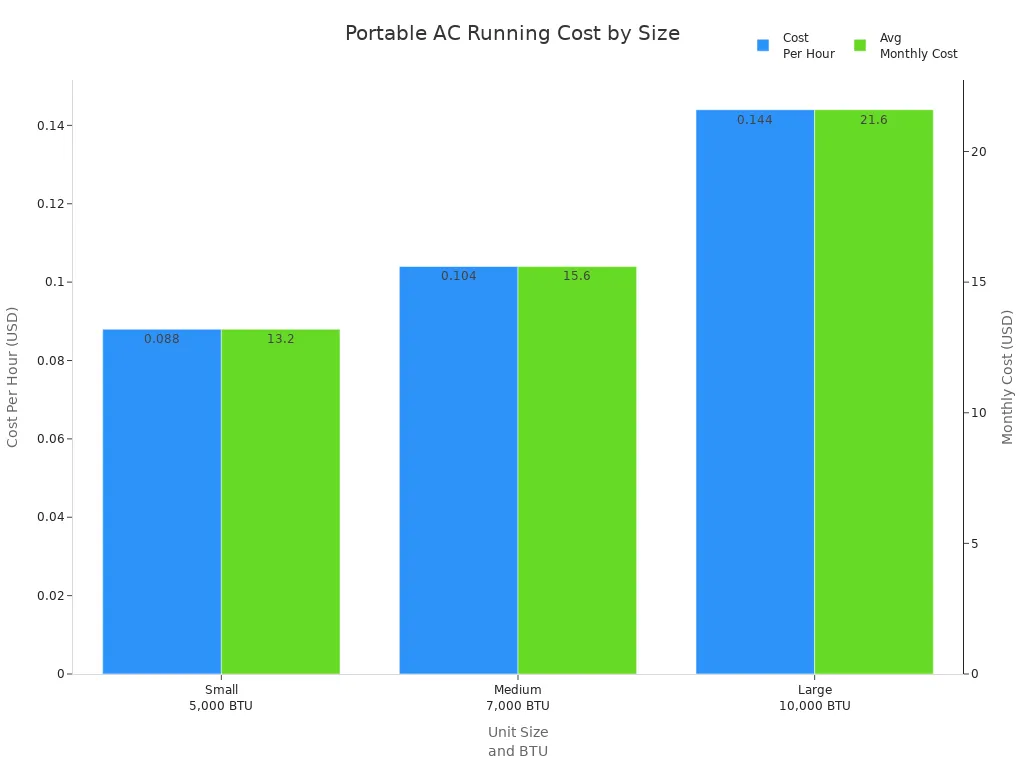
If you want to calculate the cost of running a portable air conditioner for your own home, just follow these steps. This method works for any unit size or electricity usage pattern. Knowing how much electricity your portable AC uses helps you plan your energy budget and avoid surprises on your bill.
If you want to know why running an air conditioner costs what it does, you need to look at a few main things. These are the size of your unit, how efficient it is, how much electricity costs where you live, and how you use your portable AC. Each of these can change your monthly bill a lot.
The size of your portable air conditioner is measured in BTUs. Bigger BTU units cool bigger rooms but use more power. When wattage goes up, your electricity cost goes up too. You should pick a BTU rating that matches your room size. This helps you save energy and money.
| Portable AC Unit Size (BTU) | Approximate Running Wattage | Recommended Generator Wattage |
|---|---|---|
| 7,000 | 800 W | 2,000 W |
| 8,000 | 1,000 W | 2,000 W |
| 10,000 | 1,200 W | 2,000 W |
| 12,000 | 1,500 W | 3,000 W |
| 14,000 | 1,800 W | 3,000-3,500 W |
| 16,000 | 2,000 W | 4,000 W |
You can see in this table that as BTU goes up, wattage and generator wattage also go up. This means you use more energy and spend more on both electricity and equipment.
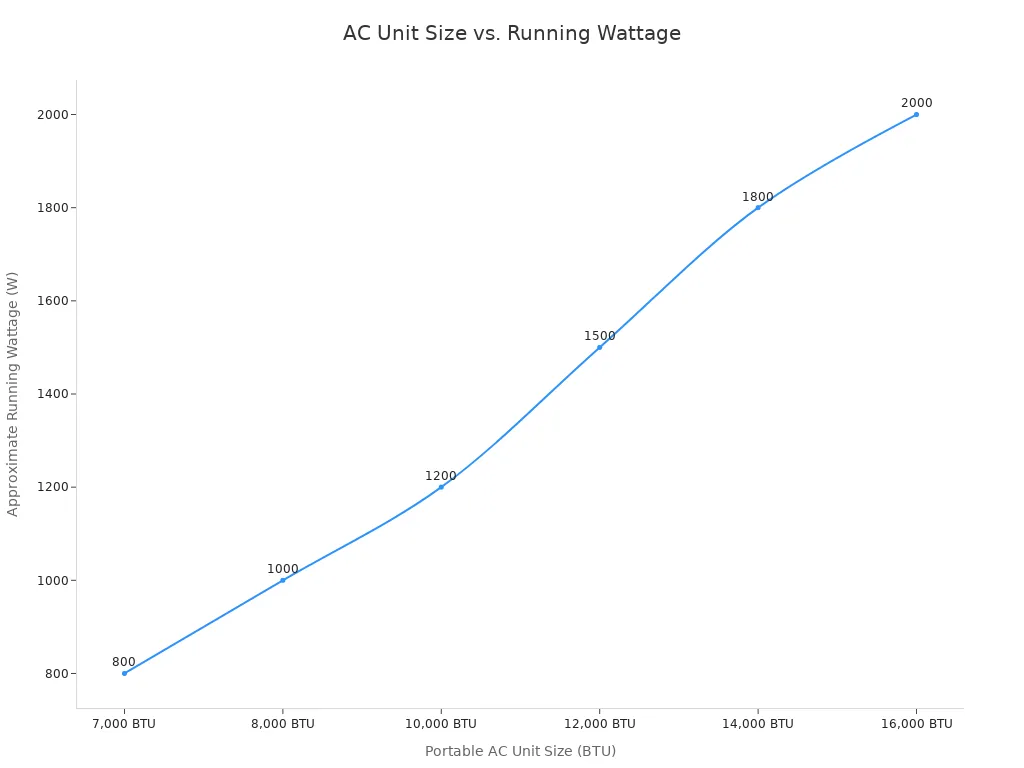
Most portable air conditioners use between 750 and 1,480 watts. The average one uses about 1,175 watts. Many models use around 1,250 watts. Some low-wattage models use 850 watts or less. How much power your AC uses depends on its BTU size and the room you want to cool.
| Portable AC Size (BTU) | Typical Power Consumption Range (Watts) | Recommended Room Size (sq. ft.) |
|---|---|---|
| 8,000 | 850 - 950 | Up to 350 |
| 10,000 | 1,000 - 1,200 | 350 - 550 |
| 12,000 | 1,100 - 1,500 | 350 - 550 |
| 14,000 | 1,250 - 1,800 | 550 - 700 |
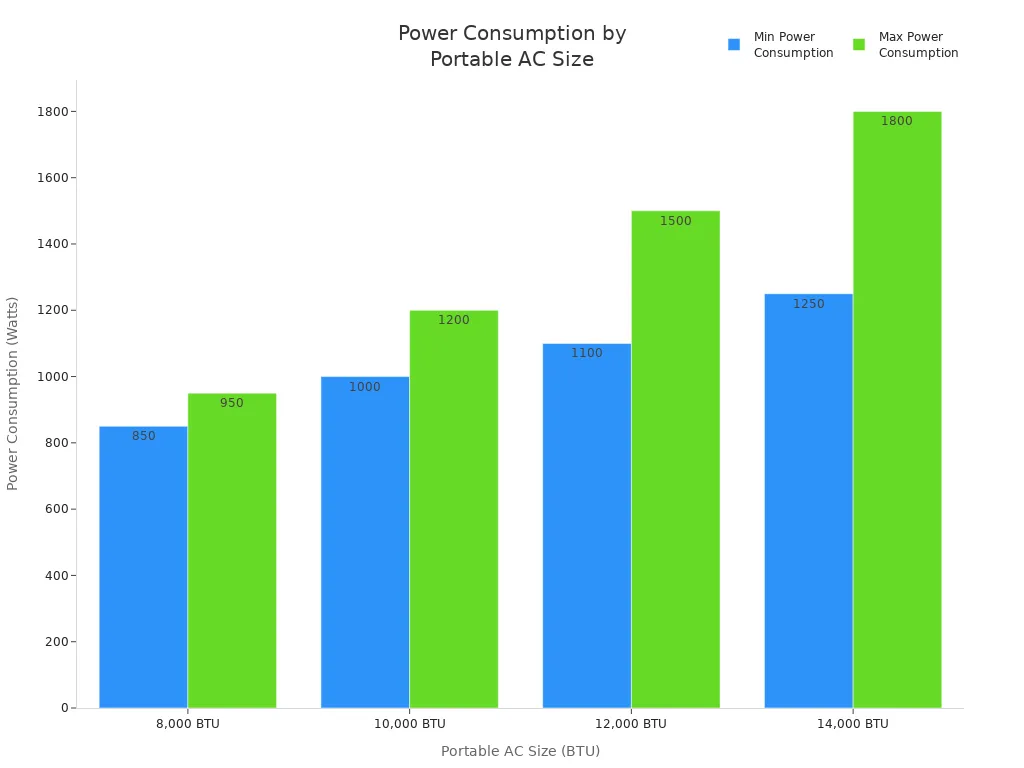
If you get a unit that is too big for your room, you will pay more for electricity but not feel more comfortable. Picking the right size helps you save money and energy.
Energy efficiency is another thing that changes how much it costs to run your air conditioner. The Energy Efficiency Ratio, or EER, shows how much cooling you get for each watt used. You find EER by dividing BTUs by the power in watts. For example, a 10,000 BTU unit using 1,200 watts has an EER of 8.33. Higher EER or CEER ratings mean the unit uses less energy for the same cooling. This lowers your electricity cost. Units with EER above 8.5 are good, and those near 10 may get ENERGY STAR®.
EER shows how much cooling you get for each watt. Higher EER means lower costs.
CEER includes standby power, so you see the full efficiency.
High EER or CEER units use less electricity and save you money.
If you pick an energy-efficient portable air conditioner, you spend less on electricity each month. Some models with inverter technology change their speed to match how much cooling you need. This can cut energy use by up to 30%. Features like timers and smart thermostats help you avoid wasting energy. Over time, these savings add up. Buying an efficient unit can be worth it. In some places, using an efficient portable AC can save you $10 to $25 each month compared to central AC.
How much you pay for electricity in your area makes a big difference in your total cost. Rates can be very different from state to state. For example, running a 1,200W portable AC for 8 hours a day costs about $34.50 per month in Texas, $43.20 in Minnesota, $75.60 in California, and $115.20 in Hawaii. Even a small change in the rate can make your bill much higher.
| Region/State | Typical Electricity Rate (¢/kWh) | Estimated Monthly Cost for 1,200W Portable AC Running 8 Hours Daily |
|---|---|---|
| Texas | 12 | $34.50 |
| Minnesota | 15 | $43.20 |
| California | 26 | $75.60 |
| Hawaii | 40 | $115.20 |
The cost to run your air conditioner also changes with the seasons. You use your AC more in the summer, so your electricity cost goes up. In hotter places, you might use your AC for more months each year. This makes your yearly cost higher. Always check your local rates and think about how long you will use your AC each season to guess your total expenses.
How long you run your portable air conditioner each day has a big effect on your energy consumption. If you use your AC for more hours, your electricity bill will go up. For example, running a 10,000 BTU unit for 8 hours every day can use about 1,000 watts per hour. Over a month, this adds up quickly. In hot climates, you might need to run your AC for 8 to 12 hours daily. This can make your monthly bill much higher than in cooler places where you use it less often.
You can estimate your monthly energy use with a simple formula:
Energy units per month = kW rating of AC × daily running hours × number of days in the month
If your AC uses 1.5 kW and you run it for 8 hours each day, you will use 360 kWh in a month. To find out how much this will cost, multiply the total kWh by your local electricity rate. The more hours you use your AC, the more energy it will need. This means your total cost will rise in a straight line with your usage.
How often and how long you use your portable air conditioner also changes your energy consumption. Turning your AC on and off many times a day can use more electricity. Each time you start the unit, it needs extra power. If you use your AC for long periods without breaks, your energy use will be higher.
Let’s look at an example. If you run a 10,000 BTU portable AC for 4 hours a day over 90 days, you will use about 360 kWh. At a rate of 40¢ per kWh, this will cost $144 for the season. If you use energy-saving features like timers or smart thermostats, you can cut your runtime by up to 30%. This helps lower your total energy consumption and saves money.
You can also use this formula to estimate your daily cost:
Daily Cost = (BTU ÷ EER) × Hours Used × Electricity Rate ÷ 1000
Smart usage habits, such as only running your AC when needed, can make a big difference. Using programmable timers or home automation can help you avoid waste. These tools can save you up to 12% on your cooling bills. By paying attention to how often and how long you use your AC, you can control your energy consumption and keep your costs down.
You might want to know which air conditioner costs more to use. Window air conditioners usually cost less each month. A 10,000 BTU portable AC uses about 1,000–1,200 watts. A window AC uses only 850–950 watts. This means window units save more energy and money.
| Aspect | Portable Air Conditioner | Window Air Conditioner |
|---|---|---|
| Purchase Cost (10,000 BTU) | $300-$600 | $200-$450 |
| Installation | Simple, DIY | More complex, may need help |
| Monthly Operating Cost | $30-$37 | $25-$30 |
| Energy Consumption | 1,000-1,200 watts | 850-950 watts |
| Efficiency | Less energy-efficient | More energy-efficient |
| Flexibility | Portable, can be moved between rooms | Fixed in one window |
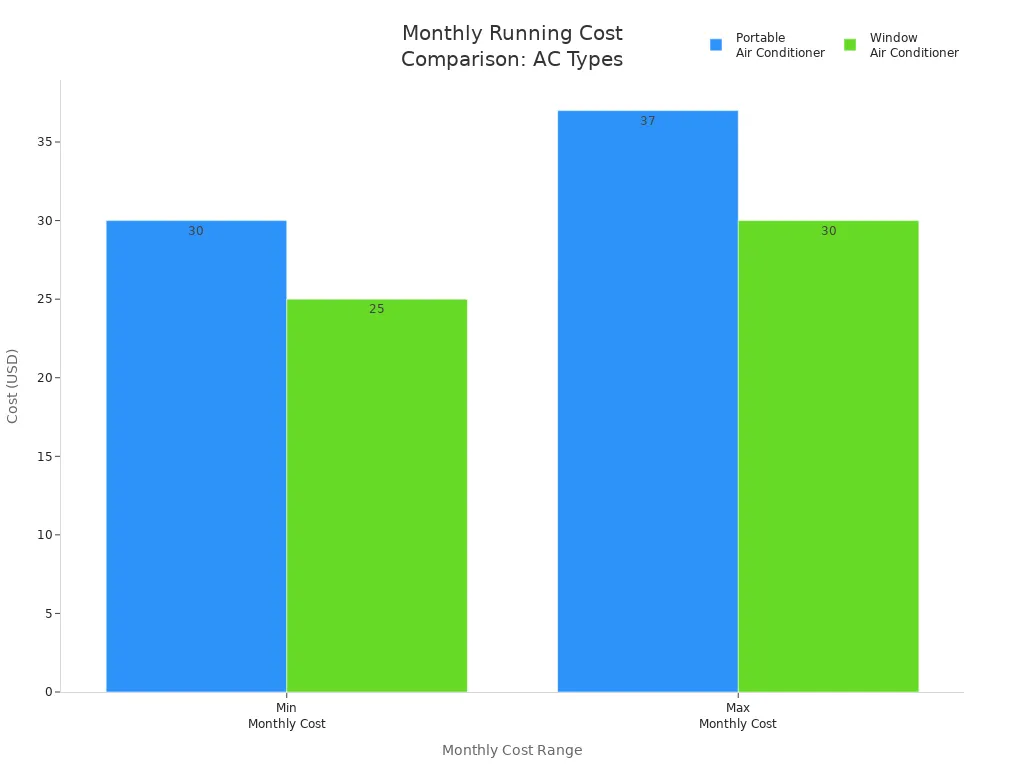
Window air conditioners cool rooms using less power. They often have better efficiency ratings. They can cool bigger spaces for less money. Portable units use more electricity for the same cooling. You will see that window ACs save more energy during summer.
| Feature | Window Air Conditioners | Portable Air Conditioners |
|---|---|---|
| Energy Efficiency | Generally more efficient; cool larger spaces at lower cost | Less efficient; typically cool smaller areas with higher cost |
| Installation | Difficult to install; requires secure mounting in window | Easy to install; plug and play without window modification |
| Space Usage | Saves exterior space; sits in window with minimal intrusion | Requires floor space; may need furniture rearrangement |
| Venting | No separate vent needed; venting integrated in unit | Requires vent hose to window, limiting placement |
| Noise | Noisier than central AC but directs noise outside | Noise inside room; hum is audible during operation |
| Cost | Higher purchase and installation cost | Generally more affordable; no installation cost |
You can set up a portable AC fast. Just plug it in and put the hose in a window. Most portable ACs have wheels, so you can move them. Window ACs need to fit tightly in a window. You might need help to install them, and they stay in one spot.
You can move portable ACs easily because of their wheels.
Window ACs are harder to install and stay in one place.
Portable ACs do not block sunlight, but window ACs do.
Portable air conditioners are good when you cannot use a window unit. If you rent or have odd windows, a portable AC is flexible. You can use it in bedrooms, garages, or offices. Window ACs are better for cooling one room all the time. They are stronger and more efficient, but need the right window.
Central air conditioning cools your whole house with ducts. Portable ACs cool just one room at a time. If you only want to cool one space, a portable AC is better. For cooling the whole house, central AC is best.
Portable ACs cost less to buy and set up. You might pay $150 to $800 for a portable AC. Central AC systems cost much more because they need pros to install them. Central AC can be more efficient for big homes.
| AC Type | Unit Size (BTUs) | Power Consumption (Watts) | Cost per Hour (USD) | Monthly Cost (USD) (8 hrs/day) |
|---|---|---|---|---|
| Portable AC | 8,000 – 10,000 | 800 – 1,000 | $0.12 – $0.15 | $29 – $36 |
| Portable AC | 10,000 – 12,000 | 1,000 – 1,200 | $0.15 – $0.18 | $36 – $43 |
| Central AC | 1 ton (12,000) | 800 – 1,500 | $0.12 – $0.23 | $30 – $54 |
| Central AC | 2 ton (24,000) | 1,600 – 3,000 | $0.24 – $0.45 | $58 – $108 |
Central AC systems have higher efficiency and cool your whole house. Portable ACs use more energy for the same cooling and only cool one room. Central ACs turn off when the house is cool, which saves energy.
Portable ACs cool one room and run all the time.
Central ACs cool the whole house and turn off when not needed.
Central ACs use special compressors to save energy.
Pick a portable AC if you need to cool one room or want to move it. Central AC is best for big homes or even cooling everywhere. Portable ACs are good for renters, small rooms, or short-term use. Central AC adds value to your home and is good for long-term use.
Here is a table to help you compare the average costs for each type of air conditioner. These numbers use typical U.S. electricity rates and 8 hours of daily use.
| Air Conditioner Type | Unit Size (BTUs) | Power Consumption (Watts) | Cost per Hour (USD) | Average Monthly Cost (USD) (8 hrs/day) |
|---|---|---|---|---|
| Window AC | 8,000 – 10,000 | 800 – 1,000 | $0.12 – $0.15 | $29 – $36 |
| Portable AC | 8,000 – 10,000 | 800 – 1,000 | $0.12 – $0.15 | $29 – $36 |
| Central AC | 1 ton (12,000) | 800 – 1,500 | $0.12 – $0.23 | $30 – $54 |
| Central AC | 2 ton (24,000) | 1,600 – 3,000 | $0.24 – $0.45 | $58 – $108 |
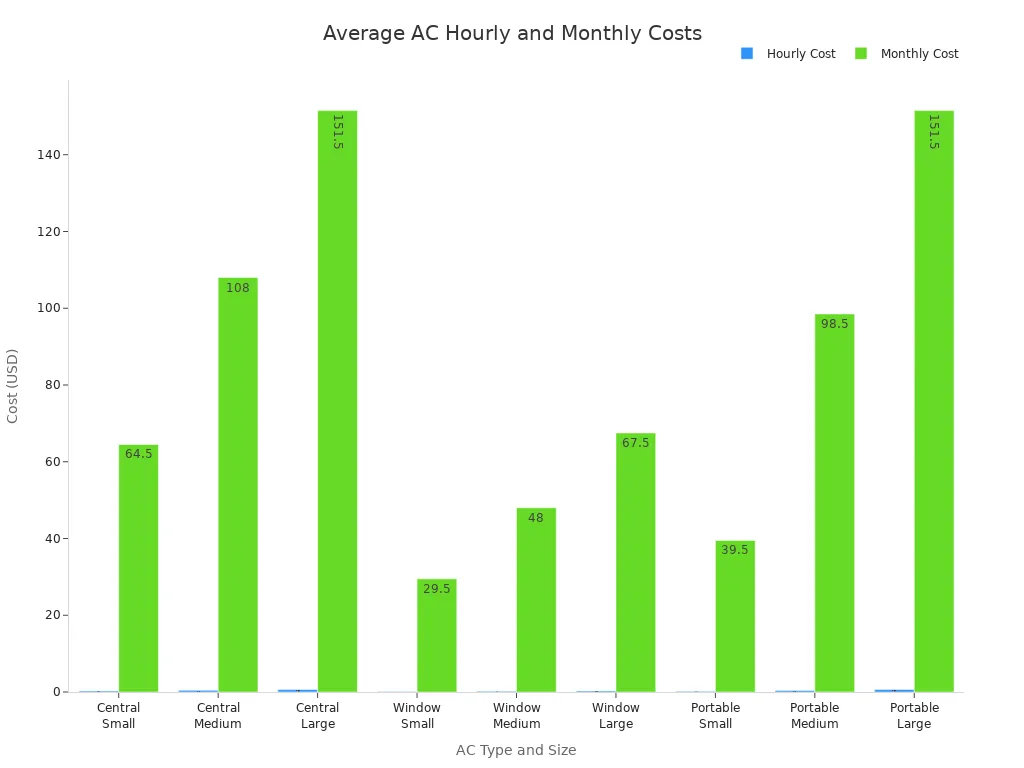
Many things change how much it costs to run an air conditioner:
Energy efficiency: Window and central ACs use less energy for the same cooling.
Installation: Portable ACs are easy to set up, but window and central units need more work.
Coverage: Central AC cools the whole house, while portable and window units cool one room.
Portability: You can move portable ACs, but window and central units stay in place.
Tip: Always pick the right AC size for your room and check the efficiency rating to save money on your energy bill.
You can save money by setting your portable air conditioner to the right temperature. The best temperature for most homes in summer is about 78°F when you are home. When you go to sleep, set it to around 82°F. If you leave for work or school, raise the temperature to about 85°F. This helps your AC run less and saves you money.
| Situation | Recommended Temperature Setting | Additional Energy-Saving Measures |
|---|---|---|
| At home | About 78°F | Use fans to feel cooler; raise thermostat by 3-4°F |
| Sleeping | About 82°F | Use programmable thermostats for automatic changes |
| Away (work/school) | About 85°F | Close curtains, seal home, avoid heat-producing activities |
Tip: Every degree you raise the thermostat can save about 6% on your cooling bill.
Most portable air conditioners have an energy-saving or eco mode. This setting lets the AC change the temperature slowly and use less electricity. Eco mode keeps you comfortable and helps you avoid high bills. Some units have smart thermostats that let you set temperature changes for different times of day.
Setting your AC to a very low temperature will not cool your room faster. It only makes the unit work harder and uses more electricity. Try to keep the thermostat at a steady, comfortable level. Using ceiling fans can help you feel cooler, so you can set the AC a little higher and still be comfortable.
Dirty or clogged air filters make your portable air conditioner work harder. This uses more electricity and raises your monthly bill. Clean or replace the filters every 1-3 months, depending on how much you use the AC. Clean filters help your unit run better and keep your indoor air fresh.
Check the vents and exhaust hoses for dust and dirt. Clean them often to keep air moving well. If vents or hoses get blocked, your AC will use more energy and your bill will go up. Good airflow helps your unit cool your room faster and more efficiently.
You should have a professional check your portable air conditioner once a year. A technician can clean the coils, check for leaks, and make sure everything works right. Regular maintenance keeps your AC running well and helps you avoid surprise bills.
Turn on your portable air conditioner only when you need it. If you leave the room, turn it off or raise the temperature. This simple habit can lower your electricity bill over time.
Many portable ACs have timers or programmable settings. Set the timer to turn the unit off after you fall asleep or before you leave home. Programmable settings let you schedule cooling times, so you do not waste electricity when no one is home.
Use ceiling or tower fans with your portable air conditioner. Fans help move cool air around the room, so you can set the AC at a higher temperature and still feel comfortable. This reduces the work your AC has to do and helps you save money.
Note: Fans should spin counterclockwise in summer to push cool air down. Turn fans off when you leave the room to save even more.
You can make your portable air conditioner work better by improving your room’s insulation. When you add insulation to your attic, walls, or crawl spaces, you help keep cool air inside and hot air outside. Without good insulation, up to 25% of your cool air can escape through the attic. This means your AC has to run longer and use more electricity to keep you comfortable.
Insulation acts like a barrier. It slows down the movement of heat. When your room stays cooler for longer, your AC does not need to turn on as often. You save money on your electricity bill and feel more comfortable during hot days.
Tip: Check your attic and walls for missing or thin insulation. Adding more can make a big difference in how cool your room feels.
Sunlight brings in a lot of heat. If you let the sun shine through your windows, your portable air conditioner will have to work harder. You can block this heat by using curtains, blinds, or special window treatments.
Window treatments like cellular shades, reflective blinds, thermal curtains, or window films can block 65% to 70% of the heat before it enters your room. This keeps your space cooler and reduces the amount of time your AC needs to run.
Here is a quick look at how different measures help your cooling efficiency:
| Measure | Effect on Cooling Efficiency and Electricity Cost |
|---|---|
| Adding insulation to attic, walls, crawl spaces | Prevents cool air from escaping and hot air from entering, reducing AC workload. Up to 25% of cool air can escape through attic without insulation. |
| Window treatments (cellular shades, reflective blinds, thermal curtains, window films) | Can block 65-70% of heat before it enters, reducing heat gain and cooling demand. |
| Sealing gaps around doors/windows with weatherstripping or caulk | Prevents air leaks, saving hundreds on energy bills. |
| Strategic landscaping (deciduous trees, green roofs) | Lowers surrounding air temperature by up to 9°F, shades exterior walls, further reducing cooling load. |
Note: Closing curtains or blinds during the hottest part of the day can make your room feel much cooler.
Air leaks around windows and doors let cool air escape and hot air enter. This makes your portable air conditioner work harder and use more electricity. You can stop these leaks by sealing gaps with weatherstripping or caulk.
Walk around your room and feel for drafts near windows and doors. If you notice any, seal them right away. This simple step can save you hundreds of dollars on your energy bills over time. When you keep cool air inside, your AC does not have to run as much.
Pro Tip: Use weatherstripping for doors and caulk for small cracks around windows. Check these areas every season to keep your room energy efficient.
By improving insulation, blocking sunlight, and sealing air leaks, you help your portable air conditioner cool your room faster and more efficiently. These steps lower your electricity costs and make your home more comfortable all summer long.
When you use a portable air conditioner, you face more than just the electricity bill. You also need to think about hidden and ongoing expenses that come with owning and running your unit. These extra tasks help your AC work well and last longer.
You need to keep your portable air conditioner in good shape. Regular maintenance helps your unit cool your room better and keeps your air clean. If you skip these tasks, your AC may use more energy and break down sooner. Here are some common maintenance needs:
Clean or replace air filters every 1 to 3 months.
Empty and clean the water tank or condensate pan, especially in humid weather.
Check and clean exhaust hoses and window-seal kits to stop leaks and mold.
Inspect for moisture buildup, which can cause mold and mildew.
Schedule professional maintenance once a year to check coils and other parts.
Neglecting maintenance can lead to higher energy use, poor cooling, and even health problems from mold.
Air filters trap dust and keep your air fresh. Most portable ACs use washable filters. You should clean these filters every month if you use your AC often. Rinse the filter with water and let it dry before putting it back. With good care, a reusable filter can last 3 to 5 years. If your filter gets damaged or too dirty, you will need to buy a new one. This adds to your yearly expenses.
| Maintenance Task | Frequency | Typical Cost Range |
|---|---|---|
| Air filter cleaning | Every month | DIY (minimal cost) |
| Water pan and condenser coil cleaning | Once per season | DIY (minimal cost) |
| Professional maintenance | Annually | $100 to $300 |
| Portable AC repair | As needed | $100 to $350 |
Portable air conditioners pull moisture from the air. This water collects in a tank or pan inside the unit. In dry places, you may only need to empty the tank once in a while. In humid areas, you might need to drain it every day. Some units have a hose for continuous drainage, but you still need to check for clogs or leaks. If you forget to drain the water, your AC may stop working or spill water on your floor. Regular drainage keeps your AC running smoothly and helps you avoid extra expenses from repairs or water damage.
Tip: Always check your AC’s manual for the best way to handle drainage and filter care.
You might spend anywhere from $15 to $200 each month to use a portable air conditioner. The amount depends on how much you use it and what your local electricity rates are. You can use the formula and examples in this guide to figure out your own costs. Doing regular maintenance and using energy wisely can help you save money. Before you buy, compare the cost of portable ACs with other choices. The table below shows that a portable AC can cost almost as much as central AC, even though it only cools one room.
| Parameter | Portable AC (9,000 BTU) | Central AC (Whole House) |
|---|---|---|
| Monthly Cost | ~$138 | $140 - $170 |
| Cooling Area | Single room | Whole house |
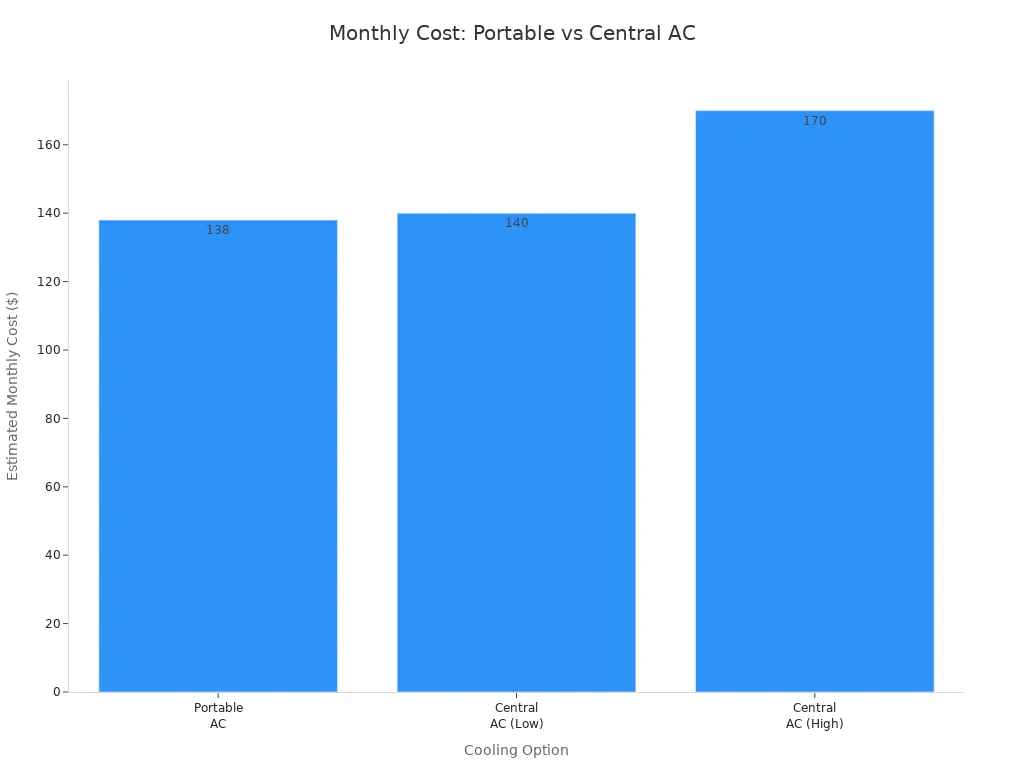
Tip: Always look at your unit’s efficiency and compare how much it costs to run. This helps you pick the best way to keep cool.
You can check the label on your unit or look in the user manual. The wattage is usually listed near the model number. If you only see BTUs, multiply by 0.293 to estimate watts.
Yes, electricity rates are often lower at night in some areas. Your AC also works less because outdoor temperatures drop. You can save money by using your AC during cooler hours.
You should avoid using extension cords. Portable ACs draw a lot of power. Using an extension cord can cause overheating or even fire. Always plug your unit directly into a wall outlet.
You should clean or replace the air filter every 1 to 3 months. If you use your AC daily or have pets, check it more often. Clean filters help your AC run better and save energy.
For most bedrooms, an 8,000 to 10,000 BTU unit works well. Measure your room’s square footage. Use the manufacturer’s chart to match the right BTU size to your space.
Portable ACs usually use more electricity than window units of the same size. They are less efficient because of extra heat loss through the exhaust hose. Window units cool rooms using less power.
You can run your portable AC all day, but your electricity bill will go up. To save money, use timers or set the thermostat higher when you leave the room.


