


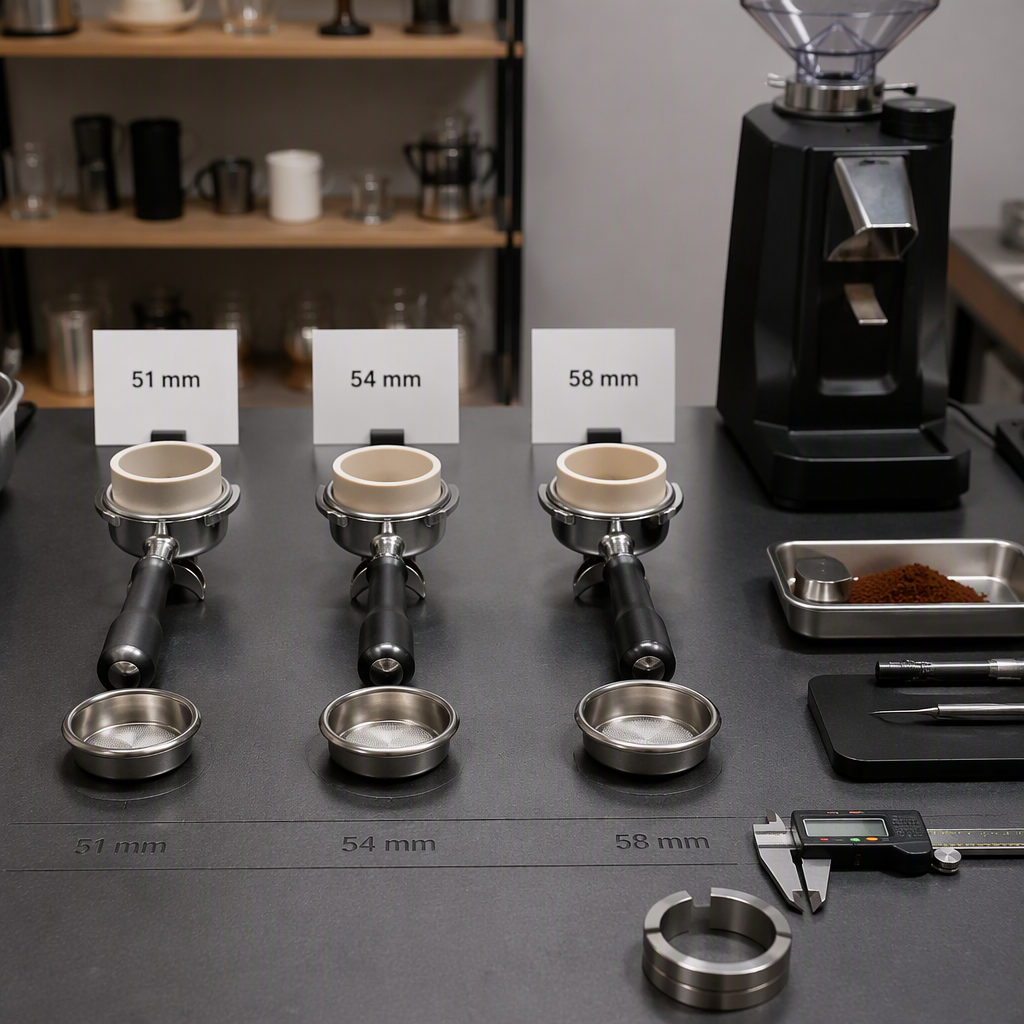
Start with basket diameter before grinder brand
The first coffee grinder dosing cup size decision is the basket and portafilter class; grinder brand fit should be checked only after the cup sits correctly with the target basket family.
| Fit question | What the buyer should verify | Why it matters |
|---|---|---|
| 51 mm class | De'Longhi identifies its DLSC085 accessory as a 51 mm bottomless portafilter. | Buyers serving compact or home espresso accessories may need a 51 mm sample path rather than resizing from a larger basket. |
| 54 mm boundary | Breville identifies a 54 mm portafilter assembly for selected Breville espresso machines. | 51 mm and 58 mm coverage does not equal universal home espresso coverage. |
| 58 mm class | Breville identifies a 58 mm portafilter assembly for selected Breville espresso machines. | 58 mm should be trialed as its own fit class, not treated as an enlarged 51 mm cup. |
Do not convert the nominal basket number into an unverified tolerance. For sourcing, request drawings or samples from the supplier, then test against the actual basket, portafilter ears, handle angle and grinder platform used by the end customer.
Choosing dosing cups for 51 mm baskets
For 51 mm baskets, specify the cup around the exact portafilter family and trial it with the retail customer's basket and handle geometry before confirming a stocking program.
- Confirm that the target accessory family is actually 51 mm; De'Longhi's DLSC085 page is an example of an official 51 mm bottomless portafilter listing.
- Ask for a dosing cup sample that can be tested for stable seating, clean grounds transfer and comfortable removal by the handle.
- Check whether the cup lip, height and outside wall clear the portafilter handle and any raised basket rim in the customer's workflow.
- Keep 51 mm and 54 mm trial samples separate in procurement records, because a nearby nominal size can represent a different machine family.
A 54 mm Breville portafilter assembly exists for selected Breville machines, so a 51 mm buying brief should not describe adjacent sizes as interchangeable unless the supplier proves that fit with samples or drawings.
Choosing dosing cups for 58 mm baskets
For 58 mm baskets, treat the larger cup as a separate configuration and verify both the portafilter family and the dose-capacity basket the buyer plans to sell or bundle.
| Buyer check | 58 mm sourcing implication | Compatibility limit |
|---|---|---|
| Portafilter class | Run a dedicated 58 mm sample rather than approving from a smaller-cup trial. | Breville identifies a 58 mm portafilter assembly for selected Breville espresso machines. |
| Basket family and dose capacity | Ask which basket capacities and portafilter family the cup is intended to support. | La Marzocco lists Advanced Precision Portafilter Basket options by gram capacity and states that the baskets fit La Marzocco portafilters. |
| Retail presentation | Separate packaging or product data for 51 mm and 58 mm helps buyers avoid returns caused by wrong-size assumptions. | Use the supplier's own verified compatibility matrix before making any customer-facing compatibility claim. |
Basket choice may combine portafilter family and dose capacity; the La Marzocco basket page supports that point for its own baskets, but it should not be used as proof of another brand's 58 mm dimensions.
Check grinder stand, insert and handle clearance
A dosing cup can match the basket class and still fail the buying task if the grinder stand, catch-cup insert or portafilter handle blocks practical use.
Fellow's Opus gear guide states that the grinder box includes a catch cup and a catch cup insert for portafilter dosing. This is useful as a fit-check concept: grinder dosing hardware can shape the space available around a cup or portafilter.
Because the Fellow page is a competitor example, it should not be used as proof of features, compatibility or supplied accessories from 中山市风之堡电器有限公司 or any other supplier. Use it only to remind the purchasing team to trial the grinder interface, not just the basket opening.
In a retail or brand program, the practical question is simple: can the operator place the cup or portafilter in the grinder, dose without obstruction, remove it by the handle and transfer grounds without hitting the stand? That handling sequence is often where nominal size-only selection breaks down.
Run a three-point compatibility trial before ordering
Before a purchase order, test the dosing cup against three points: cup-to-basket seating, grinder stand or insert clearance, and handle removal path.
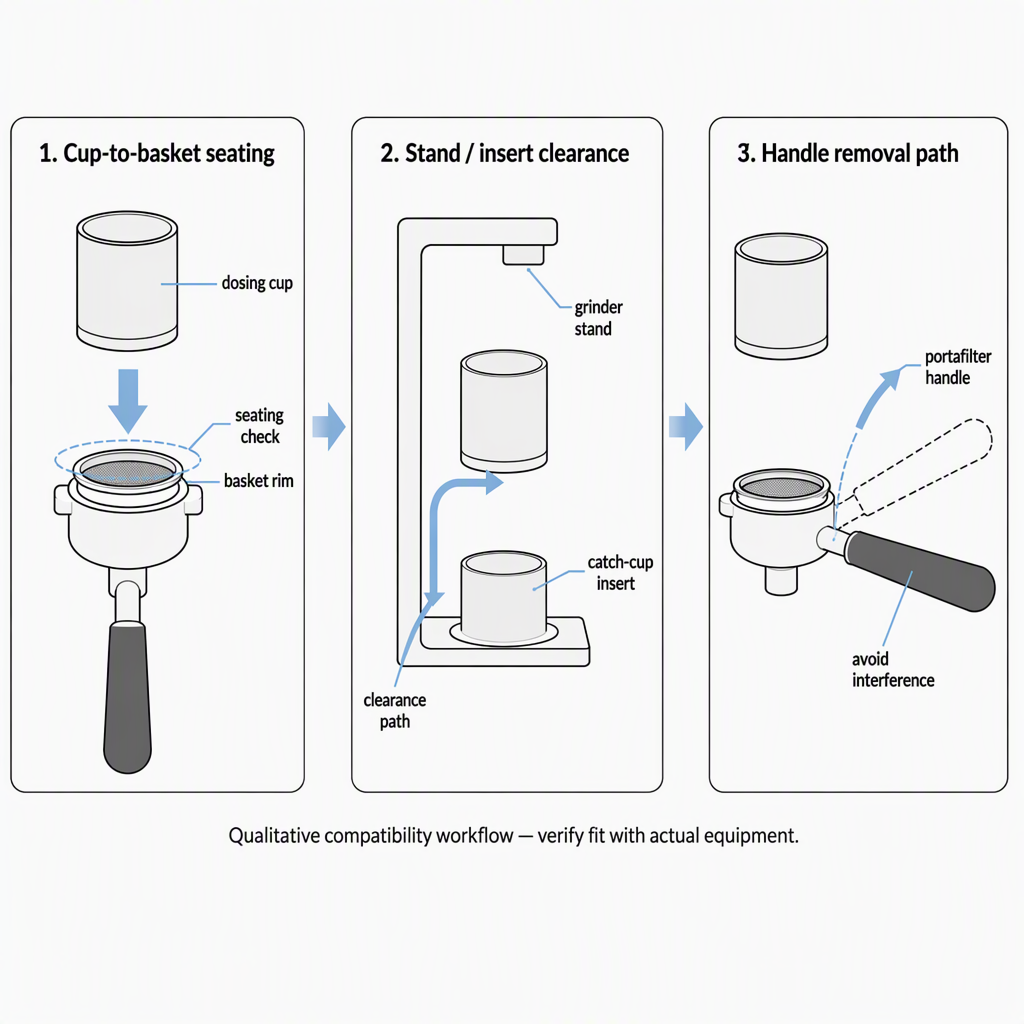
- Seat the cup with the target basket. Confirm that the cup aligns with the real 51 mm or 58 mm portafilter family selected for the program.
- Place it at the grinder. Trial the cup with the grinder stand, catch cup holder or insert that the customer will actually use.
- Remove by the handle. Check whether the portafilter handle can enter and exit the dosing position without striking the cup wall, stand or counter setup.
- Include at least one 51 mm trial setup when the assortment targets a 51 mm portafilter class.
- Include at least one 58 mm trial setup when the assortment targets a 58 mm portafilter class.
- Include a grinder-interface trial when the customer workflow uses a catch cup, insert or portafilter-dosing support.
- Record pass or fail by actual machine and accessory family, not only by the nominal basket diameter.
B2B purchasing checklist for dosing cup programs
Coffee-equipment brands, procurement teams and retailers should write the purchasing brief around verified fit families, sample testing and customer-facing compatibility limits.
- Define whether the program needs 51 mm, 58 mm or additional sizes, and keep each size as a separate approval line.
- Decide how to handle 54 mm machine families, because Breville lists a 54 mm portafilter assembly for selected machines.
- Ask whether basket capacity or basket family changes the fit claim, especially where a supplier or brand lists basket options by dose capacity.
- Request samples for the exact grinder, stand, insert and portafilter combinations expected in the selling channel.
- Require written compatibility wording that does not overstate fit across brands or machine families.
- Separate visual merchandising claims from verified engineering fit; attractive packaging cannot replace a physical trial.
| If the assortment focuses on... | Procurement action | Listing caution |
|---|---|---|
| 51 mm baskets or portafilters | Approve a dedicated 51 mm sample set. | Do not imply fit with 54 mm or 58 mm systems. |
| 58 mm baskets or portafilters | Approve a dedicated 58 mm sample set. | Confirm the portafilter family and basket capacity before publishing compatibility text. |
| Grinder dosing through a catch cup or insert | Run a stand-clearance and handle-removal trial. | Do not copy competitor accessory claims into your own product listing. |
Conclusion: specify by fit family, then sample
The safest sourcing path is to choose the dosing cup by verified fit family first, then approve it only after basket, grinder stand and handle-clearance trials.
- 51 mm is a real portafilter class shown in an official De'Longhi accessory listing.
- 58 mm is a separate portafilter class shown in an official Breville accessory listing.
- 54 mm should be treated as a boundary size, not ignored, when serving home espresso machine assortments.
- Grinder inserts and catch-cup systems make physical clearance testing part of the dosing cup decision.
For a brand, buyer or retailer, the goal is not to find one universal dosing cup size. The goal is to document which cup works with which basket family, grinder interface and handle path, then keep those limits clear in purchasing files and product listings.
FAQs about coffee grinder dosing cup size
Most dosing cup questions come down to whether the nominal basket size, grinder interface and customer-facing compatibility claim have all been tested together.
Is a 51 mm dosing cup interchangeable with a 58 mm dosing cup?
No. A 51 mm and a 58 mm program should be treated as separate fit classes and tested separately before purchase or retail listing.
Why mention 54 mm in a guide about 51 mm and 58 mm cups?
Breville identifies a 54 mm portafilter assembly for selected machines, so buyers should not assume that covering 51 mm and 58 mm covers every home espresso customer.
Can basket dose capacity affect the dosing cup brief?
Yes. La Marzocco lists basket options by gram capacity and states that those baskets fit La Marzocco portafilters, which shows why buyers should check basket family and dose option together.
Should the grinder brand be the first selection filter?
Usually no. Start with the basket and portafilter class, then test the grinder stand, insert and handle path as the second layer of fit.
Can a competitor grinder guide prove a supplier's dosing cup compatibility?
No. Fellow's Opus gear guide is useful only as a competitor-context example of catch-cup and insert hardware; it is not evidence of another supplier's product features.
What should a retailer ask for before listing a dosing cup?
Ask for the target size class, compatible portafilter families, sample results with the intended grinder setup and clear wording that limits fit claims to tested combinations.
Are exact dosing cup tolerances available from these sources?
No exact universal tolerance is established by the cited product pages. Buyers should request supplier drawings or samples and verify fit with the actual equipment set.


