


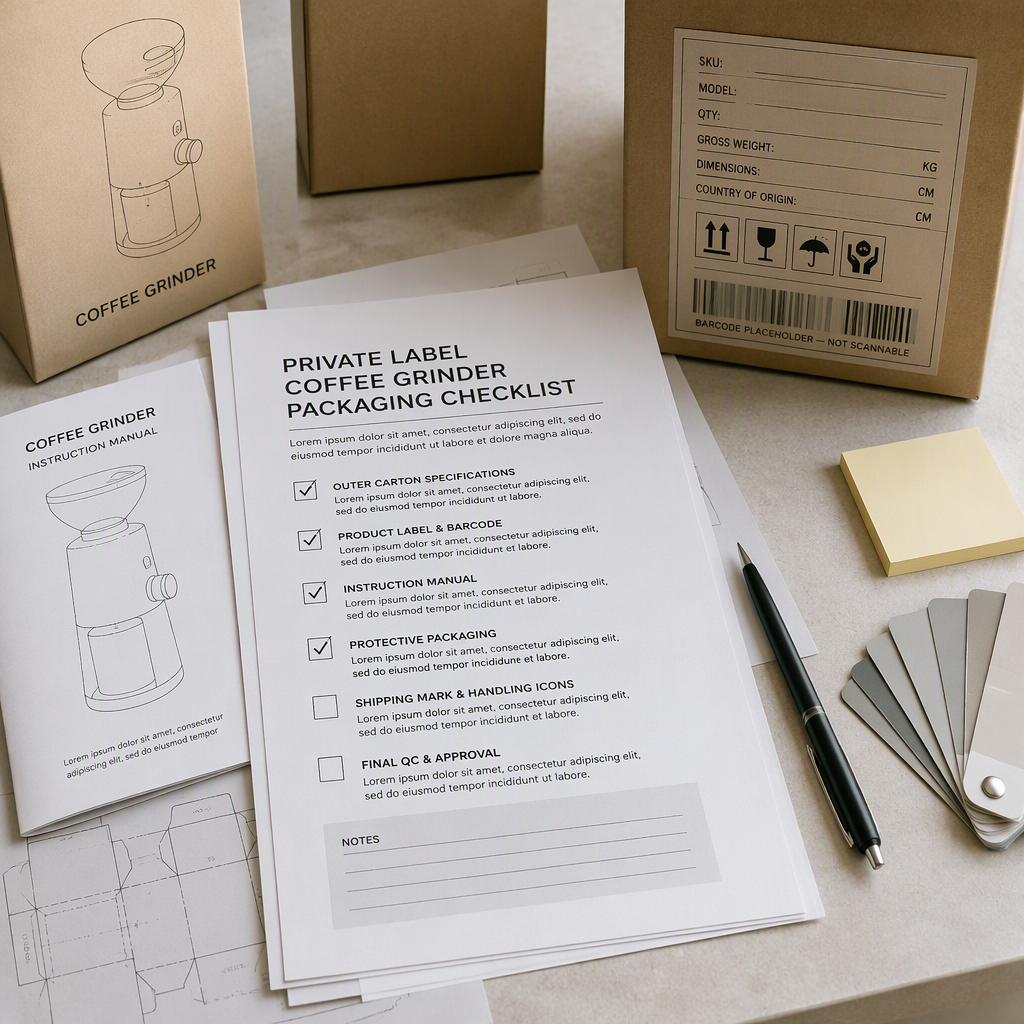
Start With Barcode And GTIN Evidence
Procurement should verify who owns the barcode, which product variant it identifies, and whether the identifier is suitable for the retailer, marketplace, carton and pallet contexts being planned.
| Packaging item | What to verify | Buyer decision |
|---|---|---|
| Unit barcode or GTIN | Confirm the identifier maps to the exact private label coffee grinder SKU, not a similar color, plug, bundle or market version. | Approve only after the brand owner and sales channel agree which number appears on retail packaging. |
| Case and logistics labels | GS1 US states that GS1 identifiers can support product, location, mixed-case and pallet identification contexts. | Decide whether outer cartons, mixed cartons or pallets need separate identifiers before printing. |
| Artwork placement | Barcode scannability depends on the final printed artwork and packaging surface, so the buyer should require a pre-production artwork and print check. | Hold mass-print approval until the barcode file, size, contrast and location are reviewed by the receiving channel. |
- Request the barcode number, barcode artwork file, packaging side where it will print and the SKU that the number identifies.
- Ask whether the same grinder sold with a different plug, manual language, bundle or carton quantity needs a different product identifier.
- Verify retailer or marketplace barcode acceptance separately; the GS1 US page supports identifier scope, not every channel’s listing rule.
For verification, review GS1 US guidance on UPCs, barcodes and prefixes when setting product, case and pallet identification expectations.
Verify Market Language, Warnings, And Safety Information
Do not approve private label coffee grinder packaging from an English-only mockup unless the target markets, required languages, safety statements and responsible-party review have been confirmed.
The European Commission product-safety page identifies the General Product Safety Regulation as the EU framework for ensuring that only safe products are available on the market, but this high-level source is not a complete country-by-country labeling manual.
Because instructions for use can relate to safe use and market, legal or regulatory obligations, language review should cover the retail box, rating-label references, inserts and user manual together.
- List every target sales market before translation starts, including online marketplaces that ship cross-border.
- Ask the supplier and regulatory reviewer which product-safety warnings, importer or responsible-party details, recycling marks and electrical-product labels apply to each market.
- Check that the same terminology appears consistently across the box, quick-start guide and full instruction manual.
- Treat legal wording as a market-specific compliance question; do not let a generic packaging template become the final authority.
Confirm Carton Specifications And Shipping Marks
Carton approval should connect the retail unit, master carton, mixed case and pallet information so receiving teams can identify the right product before shipment.
| Carton field | What the buyer should request | Why it matters |
|---|---|---|
| Retail unit count | Units per inner box and master carton | Purchasing, warehouse receiving and marketplace prep teams need the same pack-count basis. |
| Dimensions and weight | Carton size, gross weight, net weight and measurement unit | Freight booking and storage planning depend on carton-level data supplied by the buyer and supplier. |
| Case identification | Case label number, SKU name and whether a mixed-case or pallet identifier is required | GS1 US describes identification contexts that include product, location, mixed-case and pallet use. |
| Shipping marks | Purchase order, destination, handling marks and private label brand references | These fields reduce receiving ambiguity when the same factory or freight forwarder handles multiple brands. |
- Compare carton data in the quote, packaging dieline, shipping mark and commercial invoice before approval.
- Ask for a carton label proof before mass printing, especially when retail units and master cartons use different identifiers.
- If pallets or mixed cases are part of the route to market, confirm identification needs before final carton artwork is locked.
Review The Instruction Manual Before Artwork Release
The instruction manual should be checked before packaging artwork release because the box, insert and manual must tell the same safe-use story for the specific private label grinder version.
- Confirm that the manual covers intended use, setup, operation, cleaning, troubleshooting, maintenance, storage and disposal information relevant to safe use.
- For any cleaning, unclogging, burr access or internal access procedure, state before manual access that the user must switch off and disconnect the relevant power source, then follow only the model manual’s permitted access steps.
- Check that warnings in the manual match the warning hierarchy and wording used on the packaging and inserts.
- Verify that plug type, voltage label references, included accessories and model naming are consistent across the manual and box artwork.
- Send translated instructions through technical review, not only marketing review, because information for use is tied to safe use.
The IEEE Standards Association page for IEEE/IEC 82079-1-2019 lists the standard as active and describes its role in preparation of information for use, including instructions for use.
Use Coffee Standards As Context, Not Certification Proof
Coffee standards can help a buyer discuss grinder terminology and quality expectations, but referencing SCA material is not evidence that a supplier, product or package is certified.
The Specialty Coffee Association says its standards create a shared framework for quality, consistency, best practices, technical guidance and common industry language.
The same standards page lists SCA-320 Home Coffee Grinders as a certification standard requiring member login access, so public reference to the page should be framed as industry context, not as certification proof.
Use the Specialty Coffee Association standards page to align terminology only; request separate written certification evidence if a sales claim depends on certification.
Run A Packaging Approval Workflow Before Mass Production
A practical approval workflow moves from market definition to identifier evidence, language and safety review, carton data, manual review and final artwork sign-off before mass printing.
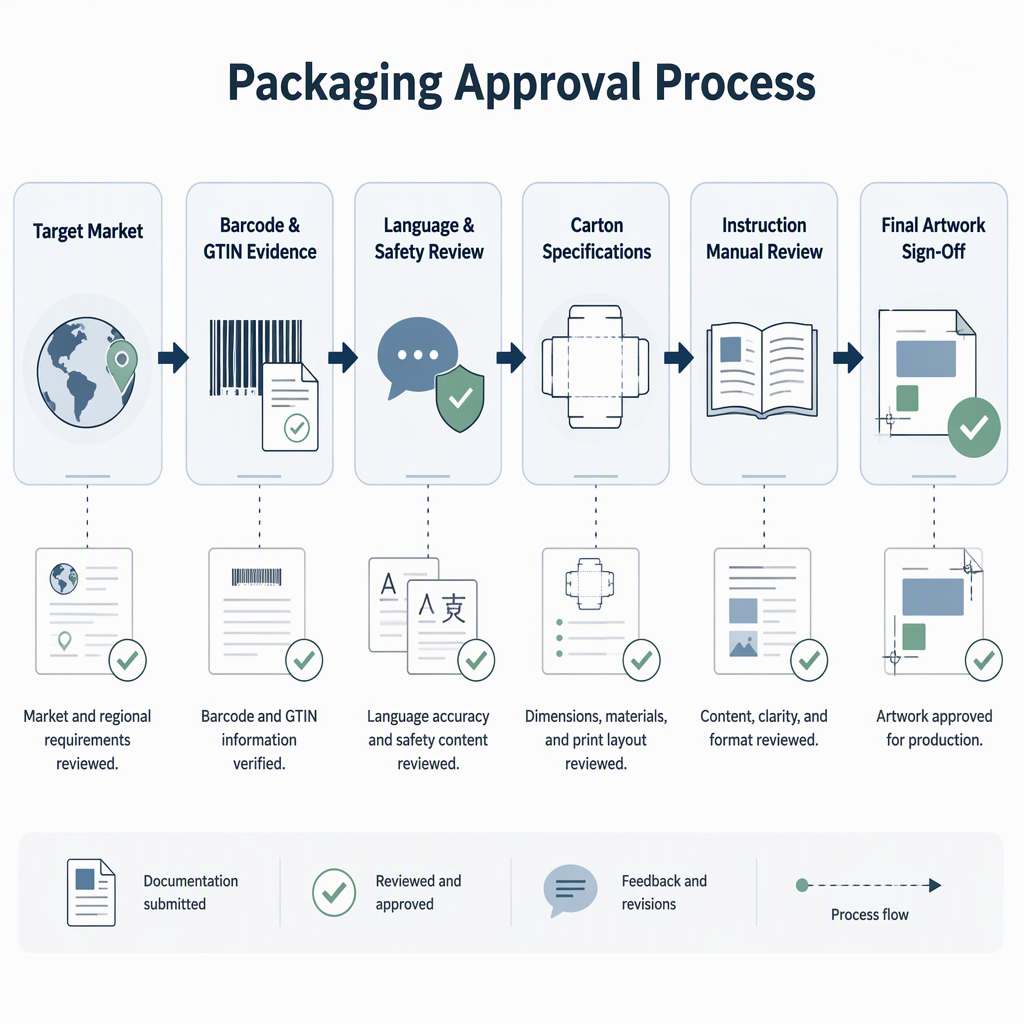
- Define the target sales markets and decide who will review product-safety, language and labeling obligations.
- Confirm barcode ownership, product identifier scope and whether unit, case, mixed-case or pallet identification is needed.
- Review retail box language, warnings, labels and importer or responsible-party details against the target market plan.
- Check carton dimensions, unit count, weights, shipping marks and purchase-order fields against logistics documents.
- Review the instruction manual and inserts before releasing final packaging artwork.
- Approve a final print proof only after identifiers, artwork files and carton labels match the purchase order and SKU structure.
- Keep one approval matrix that records the artwork file name, version, approver and approval date.
- Require a pre-production sample or printed proof when barcode position, small warning text or carton marks are hard to judge on screen.
- Do not treat a supplier template as approved packaging until the buyer has verified identifiers, languages, carton details and instructions.
Final Procurement Checklist For Private Label Packaging
Before approving private label coffee grinder packaging, collect the documents that prove the artwork matches the SKU, market, carton route and information-for-use package.
- Barcode number, barcode artwork file and written confirmation of the product, case or pallet context it identifies.
- Final retail box dieline, artwork version and approved color, text and placement proof.
- Target-market language list, safety-label review record and responsible-party labeling review where applicable.
- Master carton specification, including dimensions, weight, unit count, shipping marks and carton label proof.
- Instruction manual, quick-start insert and translated versions reviewed against the final product configuration.
- Any coffee-standard or certification-related claim supported by separate written proof, not by a general standards reference alone.
- Approve identifiers before artwork, not after mass printing.
- Review languages and safety statements by target market.
- Lock carton data and shipping marks before freight planning.
- Check instructions for use as part of packaging, not as a later document.
- Use coffee standards for terminology unless separate certification proof is supplied.
Conclusion
The safest procurement decision is to approve private label coffee grinder packaging only after identifiers, market language, carton data and instructions have been checked together.
A strong packaging file links commercial artwork to safe-use information and target-market review.
If a coffee standard is referenced, keep the claim limited to terminology or framework value unless separate certification documentation is available.
FAQs About Private Label Coffee Grinder Packaging
These answers address common procurement checks before approving retail boxes, cartons and manuals for a private label coffee grinder.
Who should own the barcode on private label coffee grinder packaging?
The buyer should verify barcode ownership with the relevant GS1 organization or sales channel before artwork release, because GS1 US describes barcodes as unique identifiers for products and supply-chain contexts.
Is English-only packaging enough for global sales?
Not necessarily. Language and safety information depend on target markets, and the European Commission product-safety page supports treating safety obligations as a market-access issue rather than a generic translation task.
Does referencing SCA standards mean the grinder or packaging is SCA-certified?
No. The SCA standards page supports the use of coffee standards as a shared framework, but it does not prove certification for a specific private label grinder, supplier or package.
Which carton fields should be checked before mass production?
Check unit count, carton dimensions, gross and net weight, shipping marks, carton label proof, purchase-order details and whether any case or pallet identifiers are required.
Should the manual be reviewed before the box is printed?
Yes. IEEE/IEC 82079-1-2019 is listed by IEEE as an active standard for preparation of information for use, so the manual, insert and packaging should be reviewed together before artwork release.
Can a supplier provide the exact warning wording for every country?
A supplier may provide a draft, but buyers should obtain qualified market review because high-level product-safety sources do not replace country-specific legal and regulatory assessment.


