Why coarse grind matters in cold brew
Coarse grinding matters because cold brew extraction is affected by particle diameter as well as water volume, temperature, brew time, and the structure of the coffee particle matrix.
In a Scientific Reports cold brew study, the researchers identified water volume, temperature, coffee particle diameter, particle matrix porosity, pore networks, and brewing time as extraction variables; readers can review the study on time, roasting temperature, and grind size in cold brew.
A second Scientific Reports study found that grinding, extraction time, and coffee type affected physicochemical and sensory characteristics under its tested cold brew conditions.
A batch-setting workflow for bigger cold brew runs
When moving from a small test to a larger batch, keep the starting grind coarse, change only one variable at a time, and document how grind and extraction time affect the cup.
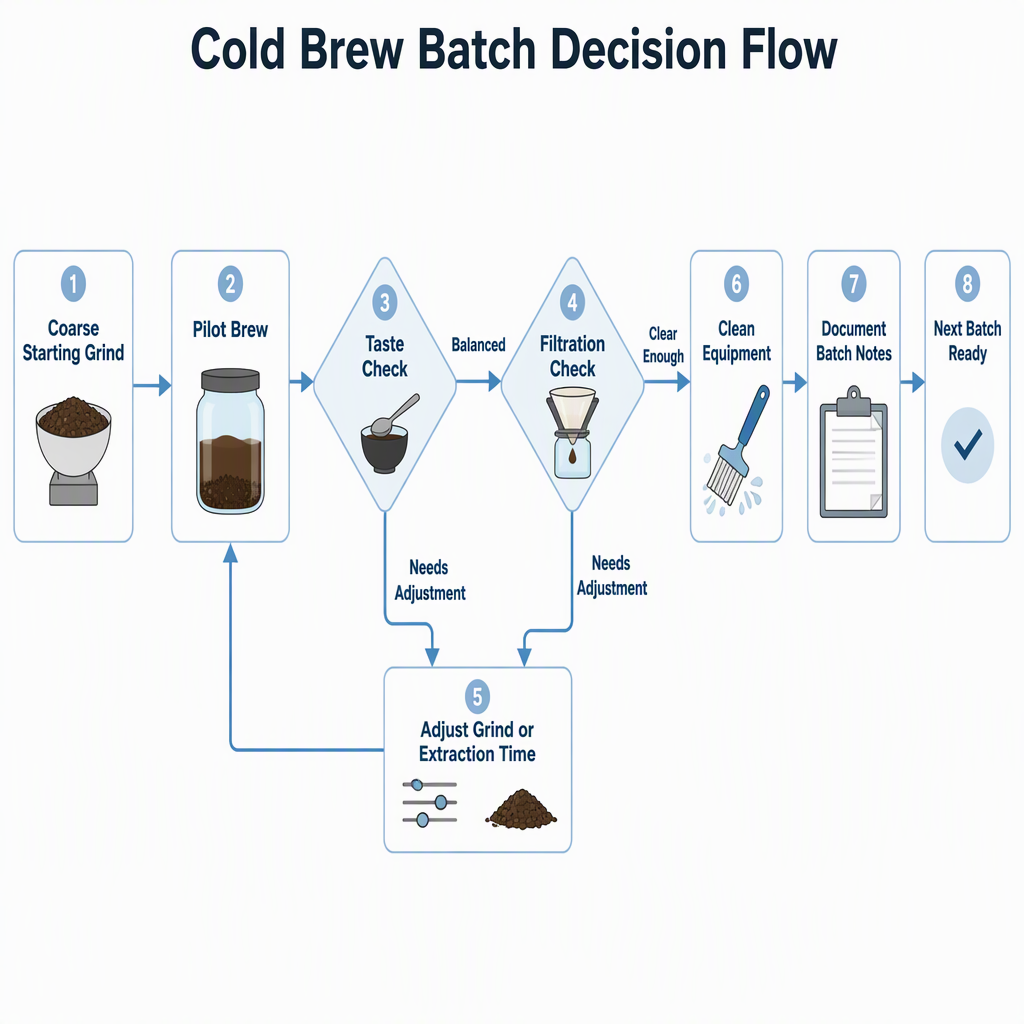
- Define the coarse starting point. Use a visibly coarse range as the first trial because research on cold brew shows grinding and extraction time can affect measured and sensory outcomes.
- Hold brew conditions steady. Keep water volume, temperature, coffee dose, vessel geometry, and brew time controlled during the first comparison because extraction depends on multiple variables.
- Run a pilot batch before scaling. Compare cup character, filtration behavior, and sediment using the same coffee before committing the setting to a larger production run.
- Adjust grind or time, not both together. If the brew is too light, first test a slightly finer coarse range or a longer time; if it is harsh or slow to filter, test a coarser range or shorter time.
- Record the approved setup. Document the coffee, roast, grind reference, grinder condition, brew time, water ratio used by the team, filtration method, and sensory decision.
Medium-coarse or coarse: a setting decision table
Use medium-coarse or coarse as test categories, not as fixed promises: the better choice depends on coffee type, extraction time, filtration, and the sensory target for the batch.
| Batch situation | Starting choice | What to watch |
|---|---|---|
| A longer cold extraction window is planned. | Start coarse and verify with a pilot brew. | Chemical and sensory results changed with extraction time and grind in the tested coffees. |
| The team is testing a new coffee, roast, or water setup. | Keep the grind coarse and hold other variables steady. | Extraction is influenced by several variables, so changing many at once makes the result hard to interpret. |
| Filtration is slow or sediment is high. | Test a coarser range before changing the entire recipe. | Treat the result as a local process finding, not a universal equipment specification. |
| Setting category | Useful when | Limit |
|---|---|---|
| Medium-coarse | Useful as a controlled test when a coarse trial tastes too light under the same brew time. | Not proven as the best larger-batch setting for every coffee or grinder. |
| Coarse | Useful as the safer starting category for many larger-batch trials because it supports filtration review and controlled time adjustments. | Still requires sensory and process validation for the specific batch program. |
Consistency checks buyers should request
For larger batches, buyers should focus on repeatable coarse output, controlled testing, and documented brew outcomes rather than asking only for a cold brew grinder setting number.
- Ask how the supplier recommends controlling grind particle diameter during cold brew testing.
- Ask whether the grinder can support repeatable medium-coarse and coarse test ranges for the coffees a retailer plans to sell.
- Ask how operators should document grind, time, coffee type, and sensory results when approving a batch recipe.
- Ask how the program will avoid changing water, temperature, grind, and time all at once during troubleshooting.
- Ask whether the approved setting remains stable after cleaning, adjustment, and normal operator use.
The buyer question is justified because peer-reviewed cold brew research found grinding, extraction time, and coffee type affected measured outcomes; the study on grinding, extraction time, and coffee type shows why setting approval should include the actual coffee and process.
Cleaning and batch-risk review
Cleaning matters in larger cold brew programs because food-contact surfaces should be cleaned as often as necessary to protect against contamination and allergen cross-contact in the US food-facility context described by 21 CFR § 117.35.
- Before opening a grinder chamber, burr area, chute, hopper, or any powered access point, switch off and disconnect the relevant power source, then follow only the access steps permitted by the model manual.
- Review which parts contact coffee and how those surfaces are cleaned between batch programs.
- Ask how retained grounds are removed so old coffee does not carry into the next larger cold brew run.
- Ask how the cleaning procedure addresses allergen cross-contact and contamination where flavored coffees or shared processing environments are involved.
- Confirm that staff can clean at the frequency required by the operating environment, not just at a convenient interval.
SCA standards boundaries for grinder-setting content
SCA standards can be referenced as an industry framework for terminology, quality, testing, and equipment-related performance discussions, but that reference does not verify Windspro certification or any product claim.
The Specialty Coffee Association describes its coffee standards as a framework covering quality, consistency, best practices, technical guidance, common terminology, equipment and brewing performance, evaluation, testing methods, and related processes.
The same public page lists SCA-320 Home Coffee Grinders as a member-access certification standard, but the page does not identify 中山市风之堡电器有限公司, Windspro, or any specific product as certified.
Buyer checklist for cold brew grinder programs
A B2B buyer should select a grinder program by testing coarse-batch repeatability, extraction-control workflow, cleaning access, and standards-language boundaries before scaling retail or private-label cold brew operations.
- Can the supplier explain how to approve a coarse setting through pilot brews rather than a universal dial number?
- Can the team keep water volume, temperature, brew time, and coffee variables stable while testing grind?
- Can operators document the coffee type, extraction time, grind reference, filtration result, and sensory decision for each approved batch?
- Can the cleaning procedure protect food-contact surfaces against contamination and allergen cross-contact risks in the relevant operating context?
- Can marketing and sales teams reference SCA standards without implying certification that has not been verified?
- Can the retailer repeat the approved process after maintenance, cleaning, staff changes, and changes in coffee origin or roast?
Conclusion
The best cold brew grinder setting for larger batches is a controlled coarse starting range validated through batch testing, not a single number copied across coffees and grinders.
- Treat grind size as one extraction variable among water, temperature, time, and coffee structure.
- Approve medium-coarse or coarse settings through pilot brews and sensory checks under the intended batch conditions.
- Build cleaning access and frequency into the buying decision for larger-batch programs.
FAQs about cold brew grinder settings for larger batches
Most cold brew grinder-setting questions have conditional answers because grind, time, coffee type, and cleaning needs interact in the actual batch program.
Does cold brew always need 12 to 24 hours?
No. One cold brew study found caffeine and 3-CGA reached equilibrium between about 6 and 7 hours under its tested conditions, while another study tested 14 to 22 hours and found grind, time, and coffee type affected outcomes.
Can the article provide exact grinder settings for every grinder model?
No. The evidence supports coarse and medium-coarse testing categories, but it does not support one exact grinder number across every grinder model, bean, roast, filtration method, and batch size.
Should a larger batch use medium-coarse or very coarse grounds?
Start coarse, then test medium-coarse only if the pilot brew needs more extraction under the same time and coffee conditions. The final choice should come from documented batch results.
Why document the setting if the operator can taste the batch?
Documentation helps separate grind effects from extraction-time and coffee-type effects, which is important because research found those variables changed measured and sensory characteristics.
Should cleaning be reviewed before changing the setting?
Yes. Larger-batch programs should review retained grounds, food-contact surfaces, and cleaning frequency because sanitation guidance for US food facilities emphasizes cleaning as often as necessary to protect against contamination and allergen cross-contact.
Does referencing SCA standards mean a grinder is SCA-certified?
No. SCA standards can provide terminology and a quality framework, but a standards reference does not prove certification, endorsement, or performance for a specific company or product.
What is the best supplier question for larger cold brew batches?
Ask the supplier to explain how operators should validate and repeat a coarse setting through pilot brews, extraction-time control, cleaning, and documentation for the intended coffee program.