E.S.E. paper pods
Treat E.S.E. as a paper-pod compatibility question tied to the E.S.E. machine and serving mark, not as proof that a capsule brew head will fit.
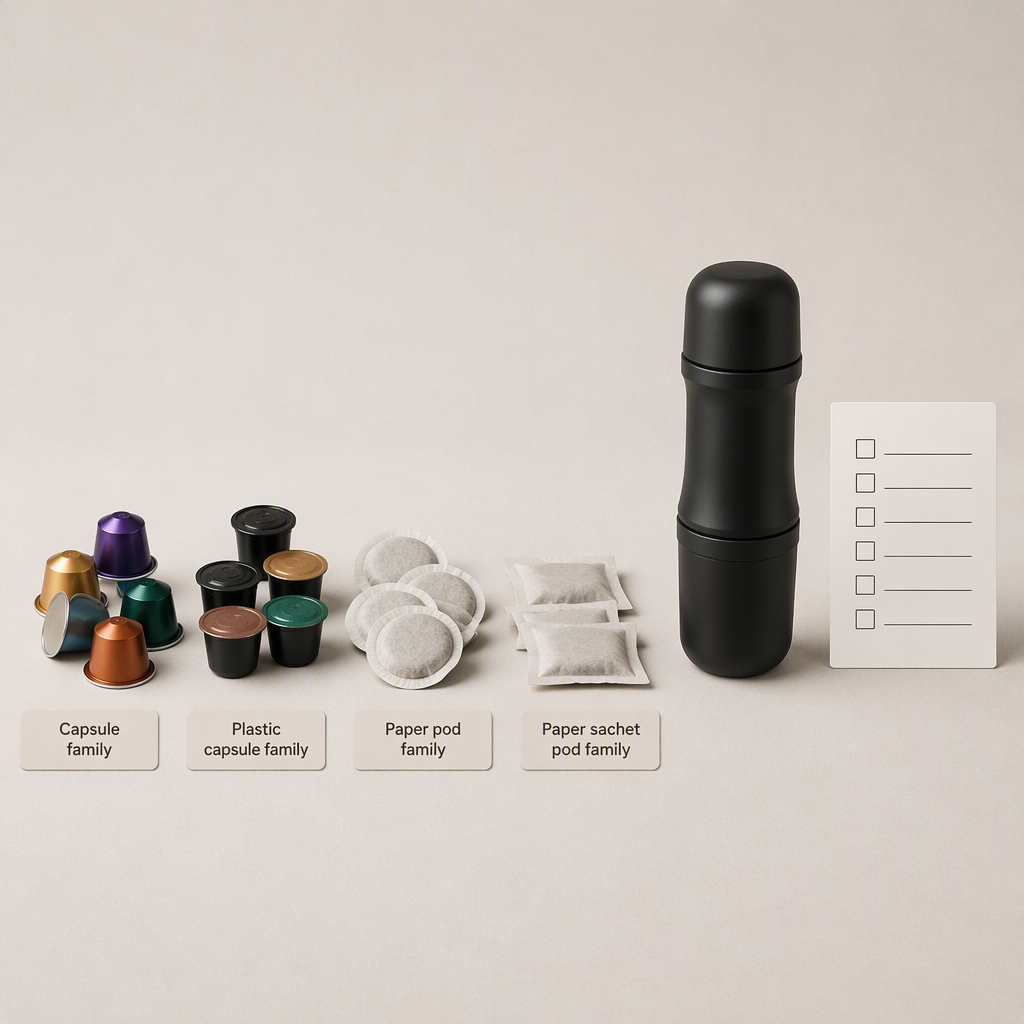
Buyers should compare capsule families as separate mechanical systems before asking whether a handheld espresso maker fits a familiar coffee brand.
E.S.E. is not the same category as an aluminum or plastic capsule system: the E.S.E. Consortium standard describes E.S.E. as an open espresso-serving system based on single pre-packaged 7 g servings sealed between filter paper for marked E.S.E. machines and servings.
Treat E.S.E. as a paper-pod compatibility question tied to the E.S.E. machine and serving mark, not as proof that a capsule brew head will fit.
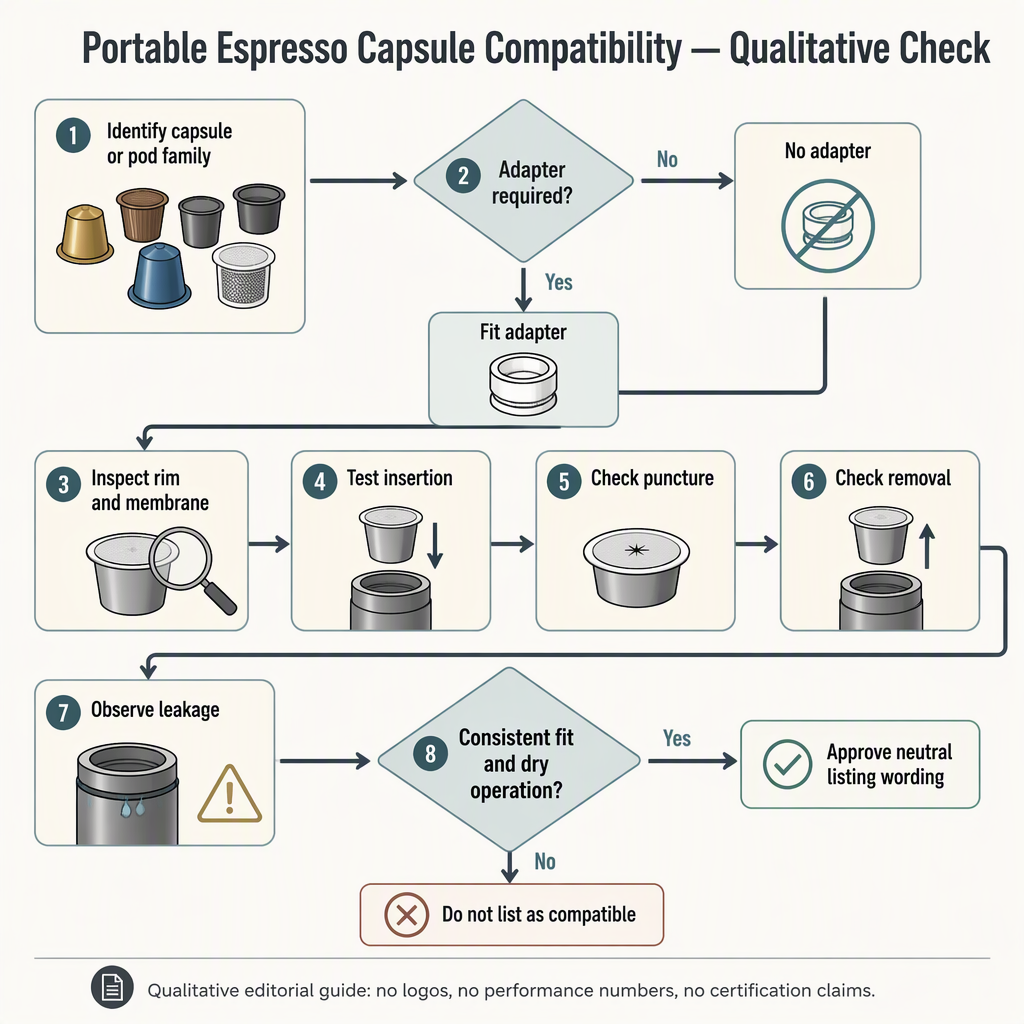
Ask whether the handheld maker uses the main brew head or a dedicated capsule basket or adapter, because capsule compatibility, puncture reliability, sealing, leakage, and cleaning boundaries are separate buyer checks.
Do not group every proprietary capsule under one listing claim; require a model-specific fit statement and sample testing for each family a supplier wants to advertise.
| Family to separate | What the buyer should verify | Risk if grouped too broadly |
|---|---|---|
| E.S.E. paper pods | Confirm the product is designed around E.S.E. servings and the current dimensional range of 43.5 to 44.5 mm diameter and 9.1 to 10.6 mm thickness. | A paper pod can be wrongly treated like a rigid capsule, leading to misleading listing copy. |
| Capsule adapter systems | Confirm the exact adapter, basket, seal, puncture interface, and cleaning boundary for the model under review. | A general capsule claim may hide leakage, failed puncture, or maintenance problems. |
| Unverified proprietary families | Request physical samples and supplier test evidence before naming a capsule family in retail content. | Listing wording can become overbroad when it names a capsule family without documentation for the exact configuration. |
Capsule fit may depend on a removable adapter rather than the handheld espresso maker body, so the approved configuration must name the adapter and the capsule family together.
Market adapter examples show why wording matters: an adapter page may define a capsule family, qualify that some compatible capsules may not work well, exclude certain membrane constructions, and limit the accessory to one machine line.
| Compatibility wording | What it usually needs | Buyer action |
|---|---|---|
| Fits the machine body | A brew head, basket, seal, and puncture path designed for that capsule or pod family. | Ask for the exact model name and the capsule families tested in that configuration. |
| Fits with an adapter | A named accessory with its own compatibility limits and exclusions. | List the adapter requirement clearly so retail customers do not expect fit in the base unit. |
| Capsule-compatible | A documented sample set covering puncture, seal, extraction, removal, and cleaning after use. | Reject broad wording until the supplier provides model-specific verification. |
Dimensional fit is only partly about diameter; buyers should also check thickness, rim shape, membrane material, puncture contact, and seal compression for the exact capsule or pod family.
Stuck capsules, failed puncture, side leakage, and water left in the chamber should be treated as compatibility test signals, not as minor after-sales details.
Before manually removing a stuck capsule, cleaning a seal area, or accessing a capsule chamber on any powered portable maker, switch the unit off, disconnect the relevant power or charging source, and follow only the access method allowed in the model manual.
| Observed symptom | Likely fit question | Buyer verification step |
|---|---|---|
| Capsule does not puncture consistently | Is the puncture plate or needle matched to the capsule top and bottom construction? | Ask for repeated sample tests across the named capsule family, including non-original compatible samples if they will be marketed. |
| Water leaks around the basket or adapter | Is the rim height or seal compression outside the adapter’s useful range? | Include a seal inspection and cleaning check when pressure leakage is observed, then retest with fresh samples. |
| Capsule sticks after extraction | Does the capsule deform, swell, or catch on the holder after pressure exposure? | Require before-and-after removal checks, not only a dry-fit photo. |
| Grounds or residue collect near the seal | Is the membrane or puncture pattern sending residue into the sealing path? | Add cleaning-boundary instructions and confirm the user can maintain the part without unsafe disassembly. |
Importers and retail brands should approve capsule wording only after the supplier provides model-specific documents, sample coverage, and clear accessory requirements.
If a supplier cannot identify the tested capsule family, adapter, and sample set, keep the listing wording narrower: describe the product as requiring supplier-confirmed capsule compatibility instead of naming a capsule system broadly.
The practical selection rule is simple: approve only the capsule families that have been verified on the exact handheld maker, adapter, and sample set that will be sold.
Use these questions to confirm whether the exact machine-and-adapter configuration has been documented with the capsule family being advertised.
No. A buyer should treat each capsule or pod family as a separate fit question and require model-specific confirmation before listing it as compatible.
No. E.S.E. is described as a paper-pod serving system for marked E.S.E. machines and servings, so it should not be merged with rigid capsule claims.
The E.S.E. Consortium states a serving diameter range of 43.5 to 44.5 mm and thickness range of 9.1 to 10.6 mm.
Not always, but buyers should ask whether compatibility is built into the brew head or depends on a named adapter, because the listing and accessory bundle must match the actual configuration.
A capsule can pass a dry-fit check but still stick after extraction if the rim, body, puncture path, or holder interaction changes under brewing conditions; removal testing should be part of approval.
Stop the test, switch off and disconnect the power source before manual access, inspect the seal area and allowed cleaning points, and retest only according to the model manual and supplier guidance.
Listing copy should name the verified capsule family, the exact adapter if required, and any exclusions the supplier has confirmed, rather than using a broad phrase such as compatible with all capsules.