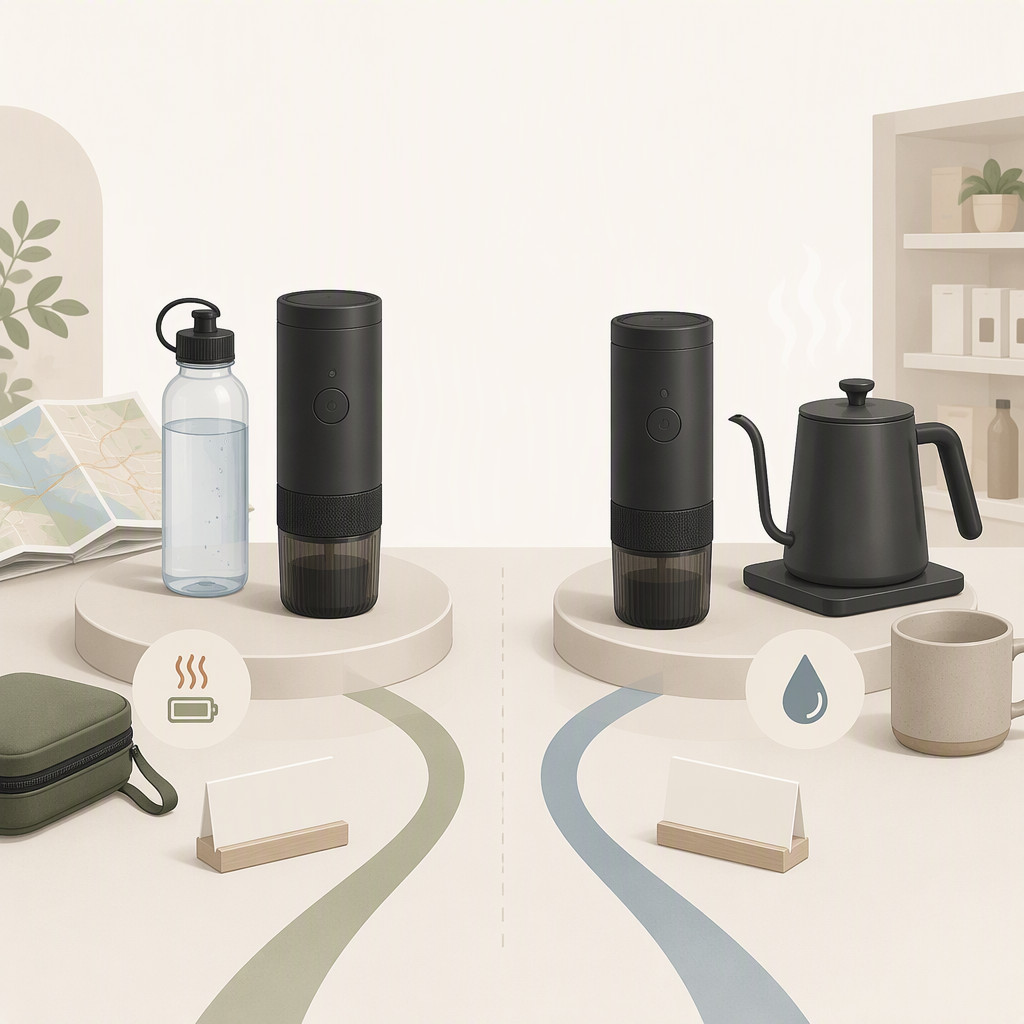
Self-heating path
Best for a channel promise built around making coffee away from a kettle, café or office pantry. The trade-off is that the product normally needs a battery system and clearer travel guidance.
For importers, retail brands and travel-gear channels, the practical choice is not that one portable espresso family is universally better. A self-heating portable espresso maker is easier to position when cold-water independence is the promise, while a hot-water portable espresso maker is simpler when the user already has reliable hot water. Build the selection around water source, expected wait, lithium-battery handling and acceptable carried weight; then ask suppliers for documented evaluation language rather than unsupported espresso claims.
Best for a channel promise built around making coffee away from a kettle, café or office pantry. The trade-off is that the product normally needs a battery system and clearer travel guidance.
Best for users who can get hot water from a hotel room, campsite stove, office dispenser or travel kettle. The trade-off is dependence on that separate hot-water source.
Choose the self-heating route when your shelf story depends on cold-water flexibility, outdoor convenience or reduced dependence on a separate kettle.
A self heating portable espresso maker can be presented around independence from a prepared hot-water source. That is useful for travel retail, camping assortments, vehicle-accessory channels and gift sets where shoppers imagine use outside a fixed kitchen.
Because the heating function usually moves more work into the device, buyers should qualify the product through supplier documentation for battery rating, charging method, water-volume limits, cleaning access and permitted operating sequence instead of relying on lifestyle copy.
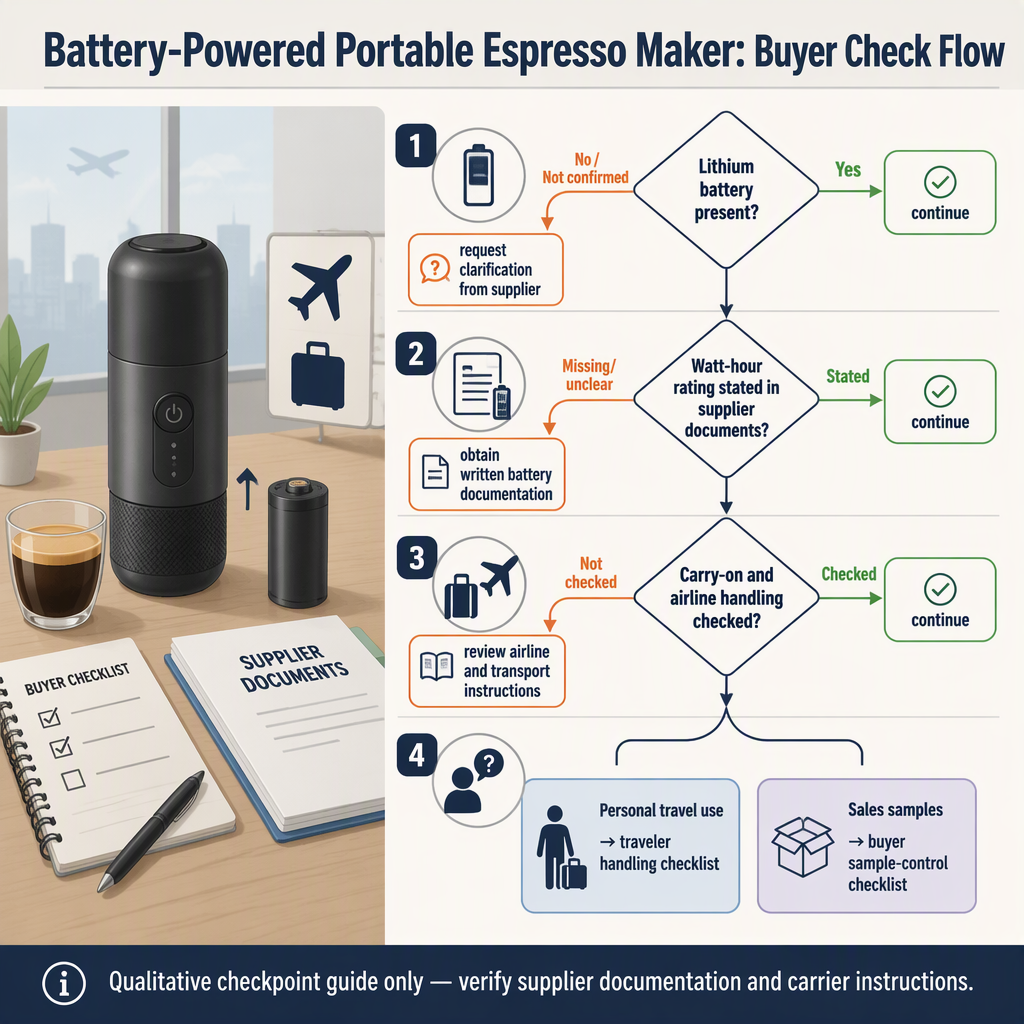
For travel positioning, do not treat a rechargeable appliance as ordinary luggage copy. The FAA states that spare lithium-ion batteries, including power banks and portable rechargers, are carry-on-only items in passenger baggage, and lithium-ion batteries are generally limited to 100 Wh per battery, with airline approval required for 101–160 Wh spares.
Choose the hot-water route when the channel can assume access to hot water and wants a simpler product story with fewer battery-related travel questions.
Hot-water portable espresso makers fit hotel, office, RV, home-gifting and travel-kettle bundles where the consumer already expects to prepare hot water. The product story can focus on compact brewing, coffee format and ease of packing rather than heating cold water inside the device.
The buyer still needs supplier data, but the questions are different: water-fill method, sealing, extraction workflow, cleaning access, compatible coffee format and user instructions. Without a heating battery, the assortment may be easier to explain for some airline, marketplace and after-sales teams.
Its limitation is clear: if the user cannot obtain hot water at the point of use, the product cannot deliver the same independent use case as a self-heating design.
Use a matrix that compares the user’s water access first, then screens waiting time, battery constraints and carried weight before requesting quotes.
| Decision factor | Self-heating portable espresso maker | Hot-water portable espresso maker | Buyer question |
|---|---|---|---|
| Water source | Designed for cold-water independence when used according to the supplier’s manual. | Depends on a separate hot-water source. | Will the shopper have hot water at the moment of use? |
| Waiting time | Waiting includes heating plus extraction, so buyers should request documented heating conditions rather than assume a universal time. | Waiting depends on how quickly hot water is available before extraction. | Where does the wait occur: in the device or before using it? |
| Battery handling | Battery-powered designs need lithium-battery travel screening against carry-on and watt-hour limits when marketed for passenger travel. | May reduce battery-specific questions if the design has no rechargeable heating system. | Does the sample, retail unit or spare battery create airline-handling questions? |
| Weight and packability | Battery and heating components can affect the acceptable carried weight; request verified product weights by configuration. | Often easier to position as a compact accessory, but actual weight must still come from supplier documentation. | Will the shopper carry it in luggage, a backpack, a vehicle kit or an office drawer? |
| If the channel promise is... | Shortlist first | Reason |
|---|---|---|
| Cold-water use away from a kettle | Self-heating | The heating function supports the central promise. |
| Simple compact brewing near known hot-water access | Hot-water | The product story avoids unnecessary heating-system complexity. |
| Air-travel accessory assortment | Either, after battery screening | FAA guidance makes lithium-battery handling a practical merchandising and sample-control issue. |
| Professional quote comparison | Either, with shared test language | The Specialty Coffee Association describes standards as shared guidelines or requirements that create common terminology, consistency, quality and best practices across the coffee industry. |
Before promoting a battery-powered portable espresso maker as travel-friendly, confirm the battery format, watt-hour rating, sample movement plan and airline-specific handling requirements.
The FAA PackSafe lithium-battery guidance says spare lithium-ion batteries, including power banks and portable rechargers, must be in carry-on baggage only; it also states that lithium-ion batteries are generally limited to 100 Wh per battery, with airline approval required for larger 101–160 Wh spare batteries.
The same FAA guidance says batteries carried for further sale or distribution are prohibited in passenger baggage. That matters for importers and sales teams carrying samples, because a personal travel rule should not be reused as a distribution rule.
Use regulator wording as a screening checkpoint, not as a global approval claim. Country rules, airline policies and product-specific battery documentation still need to be checked before packaging, marketplace copy or sales training is finalized.
Ask suppliers for comparable documents and measured conditions, not just pressure, crema or lifestyle claims.
The Specialty Coffee Association standards page describes coffee standards as documented guidelines or requirements that support shared terminology, consistency, quality and best practices; it also notes espresso-machine-related specifications and test methods among its standards materials.
For procurement, that does not prove that a portable espresso maker meets any SCA performance threshold. It supports a better buying habit: compare suppliers through defined terms, test conditions and documentation rather than vague sensory promises.
Prepare after-sales content around use environment, charging, cleaning, coffee format and failed extraction before the product reaches the shelf.
Do not promise universal capsule compatibility, aircraft approval, milk heating, warranty coverage or repair steps unless the supplier’s approved documents say so for the exact model.
The final rule is simple: sell self-heating when cold-water independence is central, and sell hot-water models when the customer already has dependable hot water.
For B2B selection, the best shortlist is the one your channel can explain accurately after purchase. Screen water source, wait, battery handling and weight first; then ask for documents that make competing quotes comparable.
The most useful buyer FAQs focus on use case, battery handling, documentation and after-sales readiness rather than unsupported headline specifications.
Choose self-heating first if the channel promise is cold-water independence. Choose hot-water first if the shopper normally has hot water available and the channel wants a simpler compact-brewing story.
Only with careful qualification. FAA guidance for lithium batteries includes carry-on-only handling for spare lithium-ion batteries and watt-hour limits, so air-travel copy should be checked against the exact battery configuration and airline rules.
Do not assume that. FAA guidance says batteries carried for further sale or distribution are prohibited in passenger baggage, so sample movement needs a separate logistics check.
There is no universal answer without model-specific data. For self-heating products, ask for heating conditions and extraction sequence. For hot-water products, include the time needed to obtain hot water.
Request verified weight for the exact retail configuration, including battery, accessories, case and packaging where relevant. Compare that weight against how the shopper will carry the product.
Standards help create shared terminology and evaluation discipline, but the public SCA standards overview does not by itself prove that a specific portable espresso maker meets a performance requirement.
Prepare for questions about charging, in-flight use, cleaning, extraction failure, grind or capsule fit, water volume and warranty topics, but answer them only from the supplier-approved manual and policy documents for the exact product.