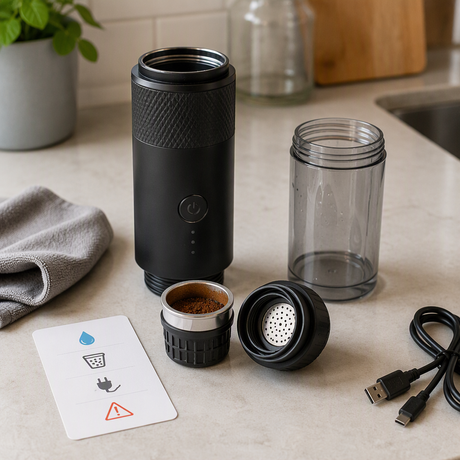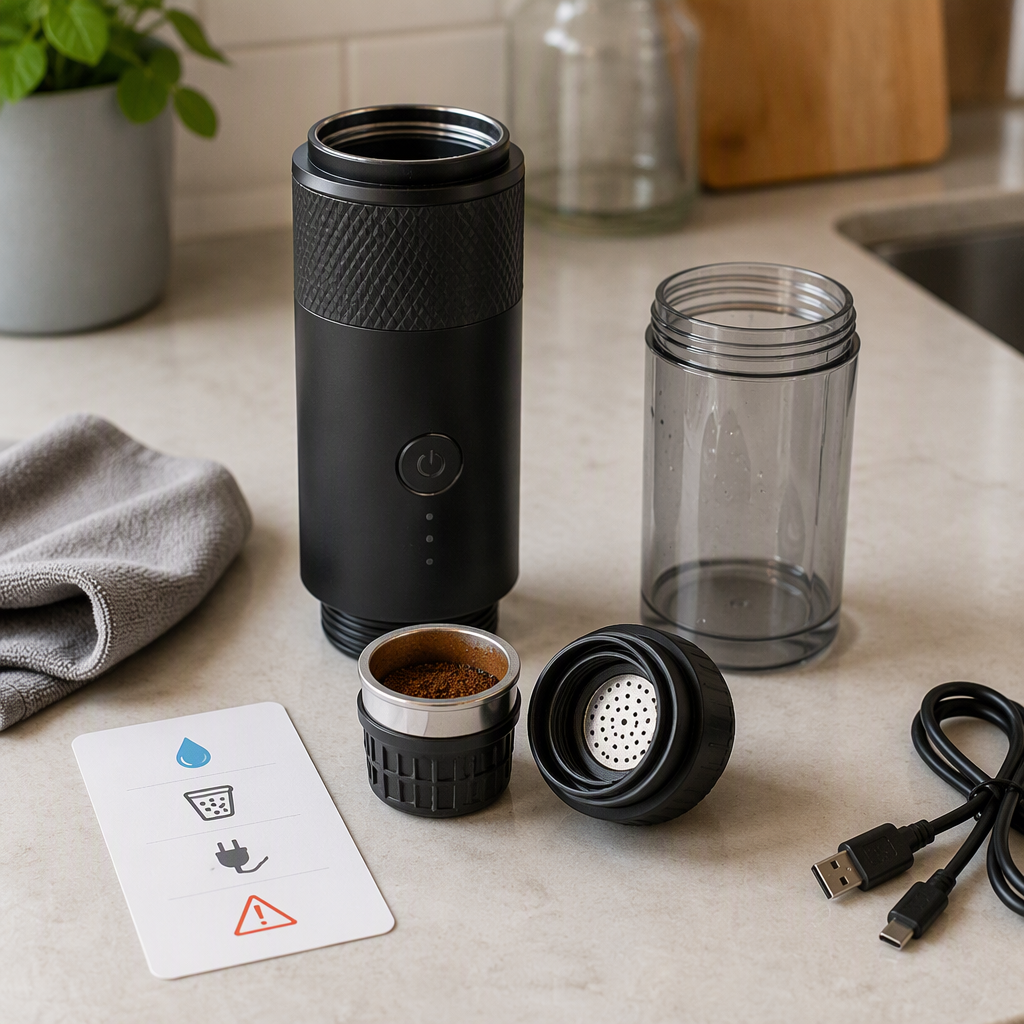
Start with water flow before changing coffee or capsules
Water flow is the first check because espresso machines can fail to draw water when the tank is not seated correctly, air blocks supply, or a water path is clogged.
- Switch the unit off and disconnect the charging cable or power source before removing, reseating, rinsing, or inspecting any accessible part.
- Remove and reseat the water reservoir according to the model manual so the outlet and seal interface align correctly.
- Check whether clean water can move through the permitted water path; if the manual provides a priming or hot-water flow step, use that procedure rather than a third-party sequence.
- If water still does not move after allowed checks, treat the issue as an escalation case instead of assuming the pump has failed.
Check the reservoir, seating, and water path
Before blaming the pump, verify the reservoir is filled, correctly seated, and able to feed water through the user-accessible path allowed by the manual.
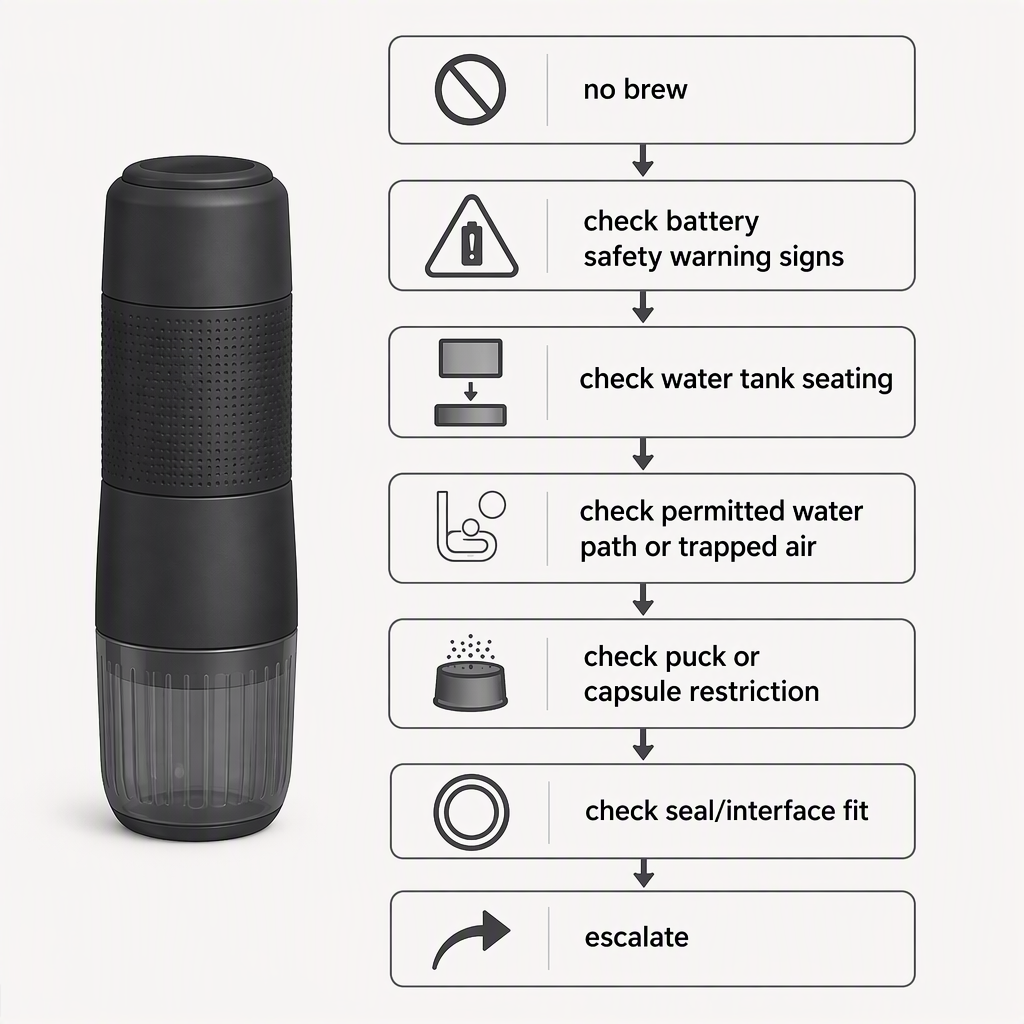
| What the user reports | Safe check | Support-team action |
|---|---|---|
| No water reaches the coffee chamber | Confirm reservoir seating and permitted inlet-path cleaning. | Ask for photos of tank position, gasket condition, and any visible blockage. |
| Water flow returns after reseating | Treat seating or trapped air as the likely first-level cause. | Record whether the symptom repeats after normal filling. |
| User wants to remove covers or probe inside the appliance | Stop the user from opening areas not allowed by the manual after switching off and disconnecting power. | Escalate to the supplier or authorized service route. |
| Heat, odor, leaking, shape change, or unusual battery noise is reported | Stop use immediately. | Move the case to safety escalation before any brewing diagnosis. |
Check the puck, capsule, adapter, and seal without copying another brand's instructions
Coffee preparation can affect extraction, so the next checks are grind, dose, puck resistance, capsule seating, adapter fit, and sealing—always within the specific model manual.
| Interface area | Why it matters | What a channel team can ask |
|---|---|---|
| Ground coffee puck | Dose, grind, and extraction variables are part of dialing in coffee and can change brewing outcomes. | Ask whether the user changed grind size, dose, or tamping approach before the no-brew symptom appeared. |
| Capsule or adapter | Category troubleshooting examples show that capsule or pod seating can be raised as a fit checkpoint, but that does not verify compatibility or instructions for another product. | Ask for the capsule type, adapter used, and whether it is listed in the product’s own manual. |
| Seal and tightening surface | Category examples also point to tightening or compartment fit as possible no-extraction contexts, but brand-specific steps must not be reused. | Ask for photos of visible seals and threads, and escalate if parts look damaged or misaligned. |
Check battery and charging state, then stop at safety warning signs
Power state can belong in a no-brew intake, but battery warning signs take priority over any attempt to brew, heat, or continue testing.
- Ask whether the unit became unusually hot during charging or attempted brewing.
- Ask whether there was swelling, leaking, odor, discoloration, or an unusual sound near the battery area.
- Ask whether the charging cable, plug, or outlet connection appears cracked, loose, or damaged.
- Record the charging state as a category-level symptom, but do not tell users to follow another brand’s charging or brewing sequence.
Know when to stop testing and escalate
Stop troubleshooting when the next step would require unsafe electrical handling, unauthorized disassembly, forced parts, or continued use despite damage.
Build a support checklist for importers and retail channels
A useful B2B intake form separates water-flow symptoms, coffee-interface variables, power condition, and safety stop signs before escalating a portable espresso maker not brewing complaint.
- Reservoir status: filled, seated, recently removed, leaking, or visibly misaligned.
- Water-path status: no water movement, partial flow, flow restored after reseating, or repeated blockage.
- Coffee variable: ground coffee, grind change, dose change, tamping change, or capsule use.
- Interface fit: capsule, adapter, basket, visible seal, or tightening surface involved in the complaint.
- Electrical safety: damaged cord, loose plug, overloaded outlet, or request to open the appliance.
- Battery safety: odor, heat, swelling, leaking, color change, odd noise, or unsafe charging condition.
| Case type | Likely support route |
|---|---|
| Water flow returns after reservoir reseating or permitted priming | Close as a first-level water-flow case if the symptom does not repeat. |
| No brew follows a change in grind, dose, or coffee preparation | Guide the user back to the product manual’s allowed coffee-preparation range. |
| Damage, loose electrical parts, or unauthorized access is involved | Stop first-level troubleshooting and escalate. |
| Battery warning signs are involved | Prioritize safety handling and do not continue brewing tests. |
Conclusion
For a portable espresso maker not brewing, the most practical first move is to prove safe water flow before changing coffee variables or escalating the case.
Reservoir seating, air in the supply path, and clogging are reasonable first-level categories. Coffee variables can affect extraction outcomes. Electrical damage or unsafe access should stop the workflow, and battery warning signs should move the case immediately into safety escalation.
FAQs about portable espresso maker water-flow troubleshooting
These FAQ answers help retail and travel-accessory teams respond consistently while staying inside safe, model-specific troubleshooting limits.
Why is my portable espresso maker not brewing even though the tank has water?
A filled tank may still fail to feed water if it is not seated correctly, if air blocks supply, or if an accessible water path is clogged.
Should I assume the pump has failed first?
No. Check safe reservoir seating and water-flow categories first, then escalate if manual-approved checks do not restore flow.
Can coffee grounds stop extraction?
Coffee dose, grind, and extraction variables can change brewing outcomes, so a very different puck or grind should be recorded as part of the diagnosis.
Can a capsule or adapter cause a no-brew case?
Capsule or adapter fit can be treated as a category-level checkpoint, but only the product’s own manual can confirm compatible parts and exact steps.
Can I clean or unclog the water path myself?
Switch off and disconnect the power source first. Then use only the cleaning or water-flow access that the model manual permits.
Can low battery be related to no brewing?
Power state can be collected as a symptom in portable espresso support, but another brand’s charging sequence should not be copied for a different model.
When should I stop using the appliance?
Stop if cords, plugs, or outlets are damaged or loose. Stop immediately if battery odor, heat, leaking, swelling, color change, or odd noises appear.