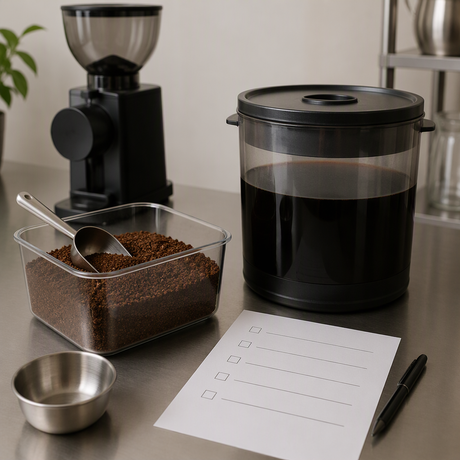
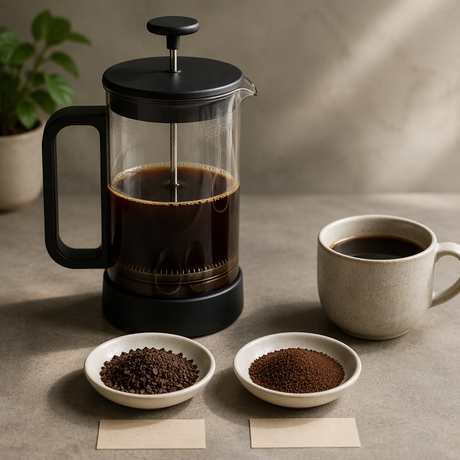
One electric grinder can be credible for both espresso and pour-over only when the buyer can verify three switching behaviors: low practical carryover between recipes, fast and understandable adjustment between grind ranges, and repeatable return to previous settings. That matters because espresso extraction is sensitive to particle-size distribution, fines, flow rate, bed permeability, extraction time, and coffee-specific preferences.
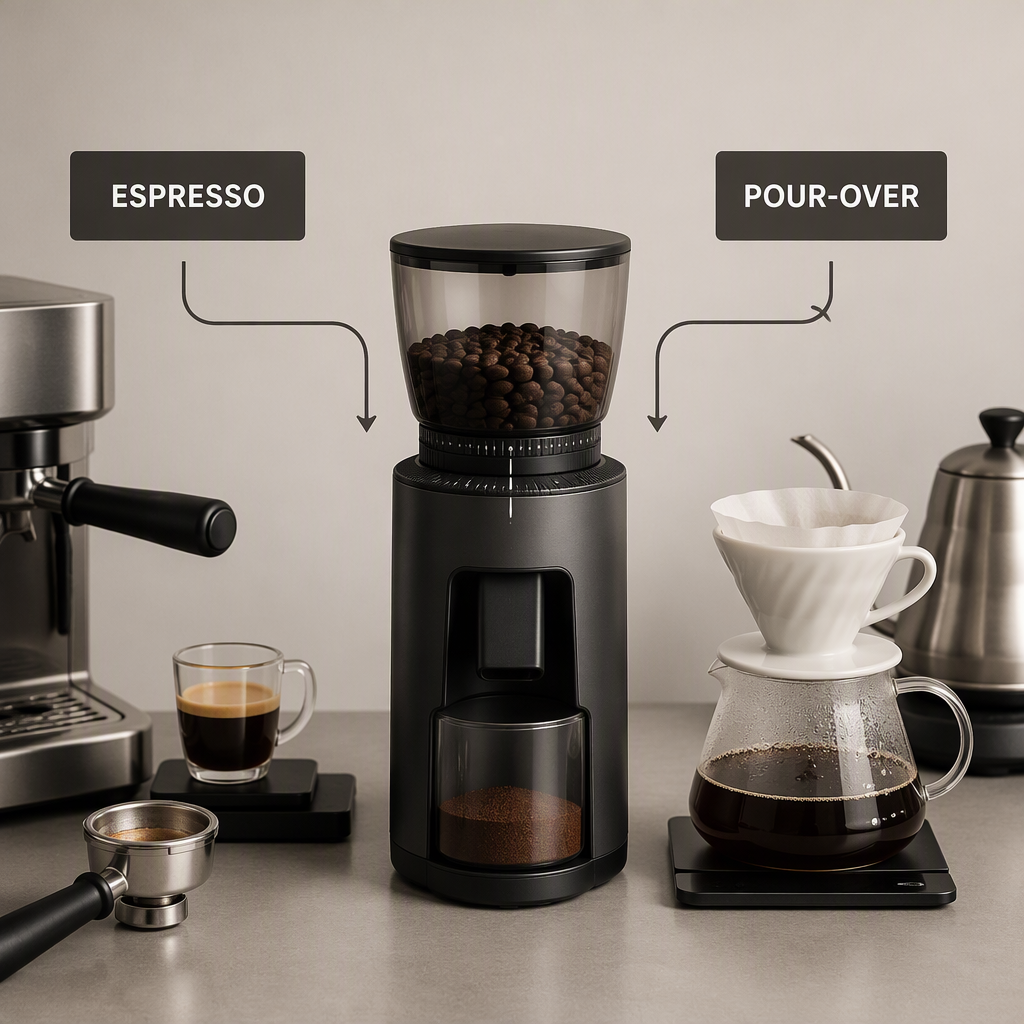
Can One Electric Grinder Handle Espresso and Pour Over?
Yes, one electric grinder can serve both use cases in a sourcing or retail lineup when it can move between the finer espresso range and the coarser pour-over range without making the user lose control of the recipe.
Do not treat the decision as a simple yes or no. Espresso particle-size distribution and fines affect flow and extraction behavior, and optimal grind size varies with coffee and preference, so buyers need predictable adjustment across the intended range.
Why Espresso and Pour-Over Pull a Grinder in Different Directions
Switching is hard because different brewing methods need different particle-size distributions, and changing too far in either direction can affect extraction.
Research on coffee particle size states that brewing methods require specific particle-size distributions; too-coarse grinding can lower extraction, while too-fine grinding can increase resistance or contact time. A grinder for espresso and pour over therefore has to support both fine control and filter-brewing movement.
Espresso is especially sensitive because fines and particle-size distribution influence flow rate, bed permeability, extraction time, and extraction dynamics, as shown in the Scientific Reports study on fines in espresso extraction.
| Buyer issue | Espresso implication | Pour-over implication | What to verify |
|---|---|---|---|
| Particle-size target | Fine changes can affect flow and extraction dynamics. | Brewing methods call for different particle-size distributions. | Can the user move between ranges without guessing? |
| Too coarse | Shot flow may become difficult to control. | Coarse grinding can lead to low extraction. | Does the coarser range still produce a usable filter recipe? |
| Too fine | Fines can change bed permeability and extraction time. | Fine grinding can increase resistance or contact time. | Can the user return to a previous setting after testing? |
The Three Checks That Decide Whether One Grinder Is Enough
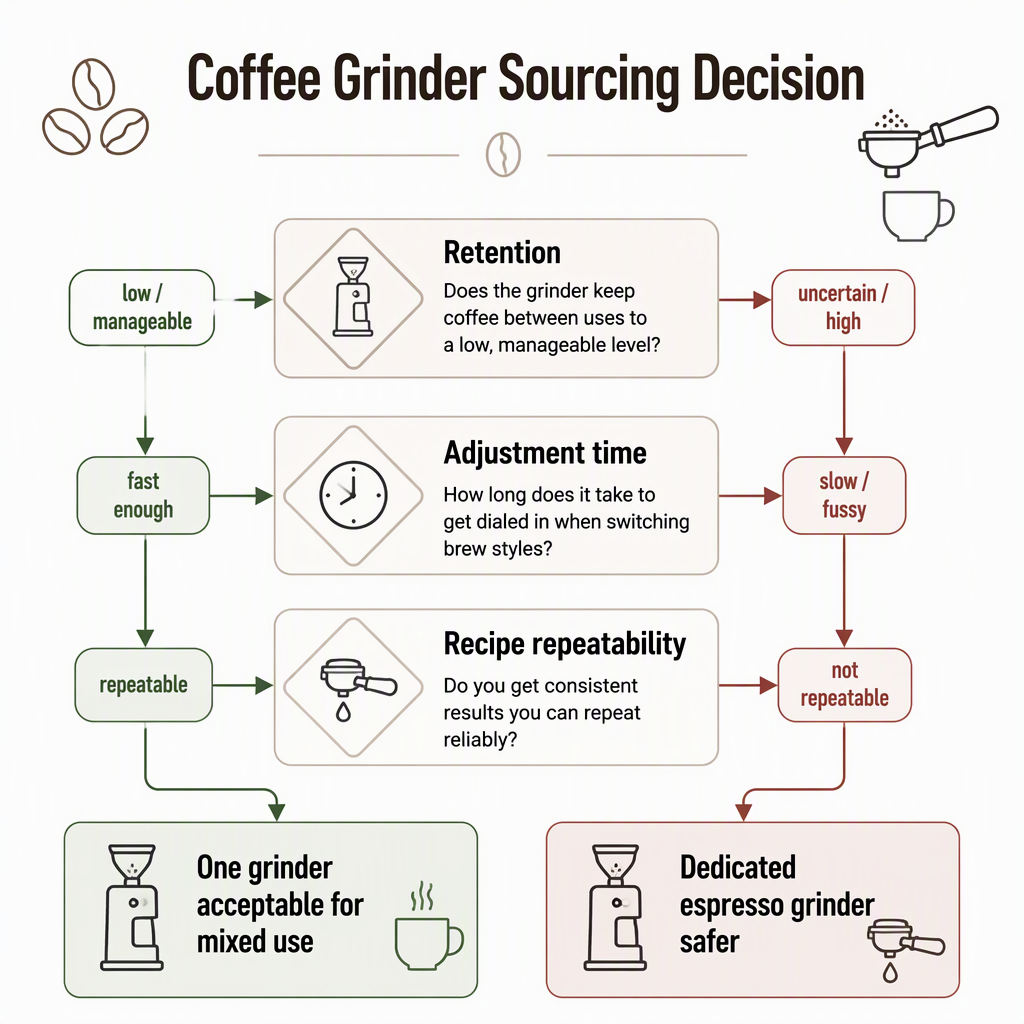
The practical decision comes down to retention between recipes, adjustment time, and recipe repeatability after the dial has moved back and forth.
Use standards language to ask better supplier questions, not as product proof. The Specialty Coffee Association describes standards as a framework for quality, consistency, best practices, shared terminology, and technical guidance; its public page also lists SCA-320 Home Coffee Grinders as a certification standard category. The SCA standards page does not prove any supplier’s grinder is certified or dual-use capable.
| Check | Pass signal | Caution signal | Buyer action |
|---|---|---|---|
| Retention | Carryover is small enough for the intended use after a normal clearing routine. | Old grounds visibly affect the next recipe or confuse tasting results. | Test recipe-to-recipe switching, not only single-use grinding. |
| Adjustment time | The user can move from espresso to pour-over and back without complex instructions. | The adjustment path is slow, hard to explain, or easy to misread. | Time the full workflow during sample evaluation. |
| Recipe repeatability | The grinder returns close enough to the prior espresso recipe for the target user, despite espresso’s sensitivity to particle distribution and fines. | The same setting behaves unpredictably after switching ranges. | Record settings, dose, beverage outcome, and user steps. |
Check 1: Retention Between Recipes
Retention should be treated as a switching risk: grounds left from one setting can disturb the next recipe, especially when moving into espresso-sensitive settings.
Because espresso extraction responds to particle-size distribution and fines, buyers should test what happens after moving from fine espresso grinding to coarser pour-over grinding, and then back again.
- Switch from espresso to pour-over and inspect the first output for obvious fine carryover.
- Repeat the test in reverse to see whether the espresso recipe is disturbed.
- Use the supplier’s normal clearing routine, and disconnect power before any manual access allowed by the model manual.
Check 2: Adjustment Time and User Friction
Adjustment time matters because a grinder that technically reaches both particle-size ranges may still be frustrating if users cannot move between those ranges consistently.
Because brewing methods call for different particle-size distributions, the adjustment system must let users cross a meaningful range without losing the target. Retail teams should test explainability as well as mechanical movement.
- Ask a first-time user to move from espresso to pour-over using only the provided instructions.
- Record scale readability, direction of movement, and whether the user can return confidently.
- Check whether espresso micro-adjustment conflicts with quick movement to filter brewing.
- Measure total changeover time, including clearing grounds and confirming the recipe.
Check 3: Recipe Repeatability After Dialing Back
Recipe repeatability is the strongest test of a dual-use grinder because it shows whether a user can return to a previous espresso or pour-over target after changing brew methods.
Espresso evidence is central: particle-size distribution and fines influence flow rate, bed permeability, extraction time, and extraction dynamics, while optimal grind size varies with coffee and preference.
Particle-size distribution is also linked to beverage properties across brewing methods, so the Springer Nature article on ground coffee particle size and distribution supports treating repeatability as a brewing-quality issue.
Test repeatability with the same coffee, dose, brew method, and operator notes across several switching cycles. The question is whether the user can recover the intended recipe after another brewing style.
Supplier Questions for Coffee Brands, Buyers, and Retailers
B2B buyers should ask suppliers for documented switching evidence and standards-aware terminology, while avoiding unsupported assumptions about certification or performance.
- Which brewing methods are explicitly covered by the instructions?
- What test method supports claims about retention, setting return, or grind range?
- Can the supplier provide sample-test guidance for moving from espresso to pour-over and back?
- If standards or certifications are mentioned, which exact standard is claimed, and can the supplier provide a verifiable certificate or official listing?
- What maintenance steps are permitted, and what safety steps apply before access to burrs, chutes, or internal grind paths?
- How should retailers explain limits to espresso-first customers?
Make any retail claim only after model-level documentation supports it.
When a Dedicated Espresso Grinder Is Still the Better Choice
A dedicated espresso grinder is the safer recommendation when the business promise depends on tight espresso repeatability, rapid service, or claims that have not been validated on the exact model.
| Scenario | One grinder may fit | Dedicated espresso grinder is safer |
|---|---|---|
| Mixed home brewing | Users accept some setup effort and value one compact appliance. | The customer expects café-style espresso consistency with minimal adjustment learning. |
| Retail assortment | The product is positioned as flexible and buyers are told how to test switching. | The package or sales script implies verified espresso performance without documentation. |
| Commercial or repeated espresso use | Only if the exact workload and repeatability requirement are modest and verified. | Espresso outcomes are central, because fines and particle-size distribution affect flow and extraction behavior. |
| Private-label sourcing | Supplier provides model-level switching documentation. | No measurement method is supplied for retention, setting return, or user workflow. |
A Practical Sample-Test Workflow Before Purchase
Before committing to a grinder for espresso and pour over, test the sample by simulating the real switching sequence a customer or retail demonstrator will perform.
- Define the target user: mixed home brewing, retail demonstration, private-label bundle, or espresso-focused buyer.
- Choose one espresso recipe and one pour-over recipe, because brewing methods require different particle-size distributions.
- Start at espresso, grind, brew, and record setting, dose, workflow steps, and result.
- Move to pour-over, then return to the original espresso setting and check whether the result is recoverable.
- Before cleaning, unclogging, or manual access, disconnect power and follow only the model manual; then summarize retention risk, adjustment time, and recipe repeatability.
Conclusion: Position the Grinder Around Verified Switching Performance
The right answer is conditional: one electric grinder can be positioned for espresso and pour-over only when switching performance is verified for the exact model and target user.
For coffee equipment brands, buyers, and retailers, the purchase decision should focus on evidence that customers can repeat in daily use. If retention, adjustment time, and recipe recovery are not documented, position the grinder conservatively or recommend a dedicated espresso grinder for espresso-first customers.
FAQs About Using One Grinder for Espresso and Pour-Over
These questions help buyers translate the technical issue into sourcing, retail, and product-positioning decisions.
Can one electric grinder really make both espresso and pour-over coffee?
It can, if the grinder can move between the particle-size distributions needed for different brewing methods and return to usable settings. The claim should be verified on the exact model.
What is the most important feature in a grinder for espresso and pour over?
The most important buying factor is not one isolated feature; it is the combination of controllable grind range, manageable retention, clear adjustment, and repeatable setting return.
Why is retention important when switching brew methods?
Retention matters because leftover grounds from the previous setting can enter the next recipe and make a switching test look less repeatable than single-use grinding.
How should retailers evaluate adjustment time?
Retailers should time the complete changeover, including setting movement, any clearing routine, user confirmation, and return to the previous recipe.
Does a numbered dial guarantee repeatable recipes?
No. A numbered dial can help users navigate, but buyers still need to test whether the same setting behaves predictably after moving across the grind range.
Does mentioning SCA standards prove a grinder is certified?
No. The SCA standards page provides industry context and lists a home coffee grinder certification standard category, but a supplier must provide separate proof for any certification claim.
When should a buyer choose a dedicated espresso grinder instead?
Choose a dedicated espresso grinder when espresso consistency is the main promise, because espresso extraction is sensitive to particle-size distribution, fines, flow, and extraction dynamics.