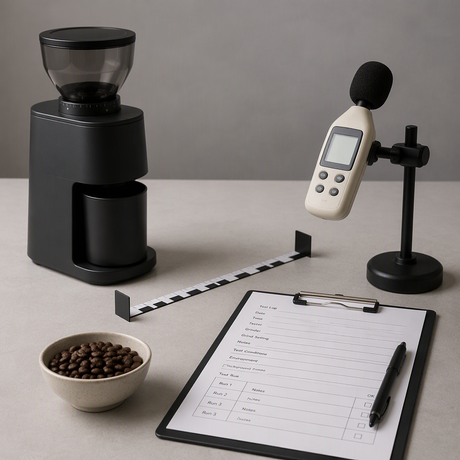
To compare coffee grinder noise fairly, compare the test method before comparing the decibel number: the same meter approach, documented distance and position, checked background noise, and consistent bean, dose, and grind conditions matter more than a standalone “quiet” claim.
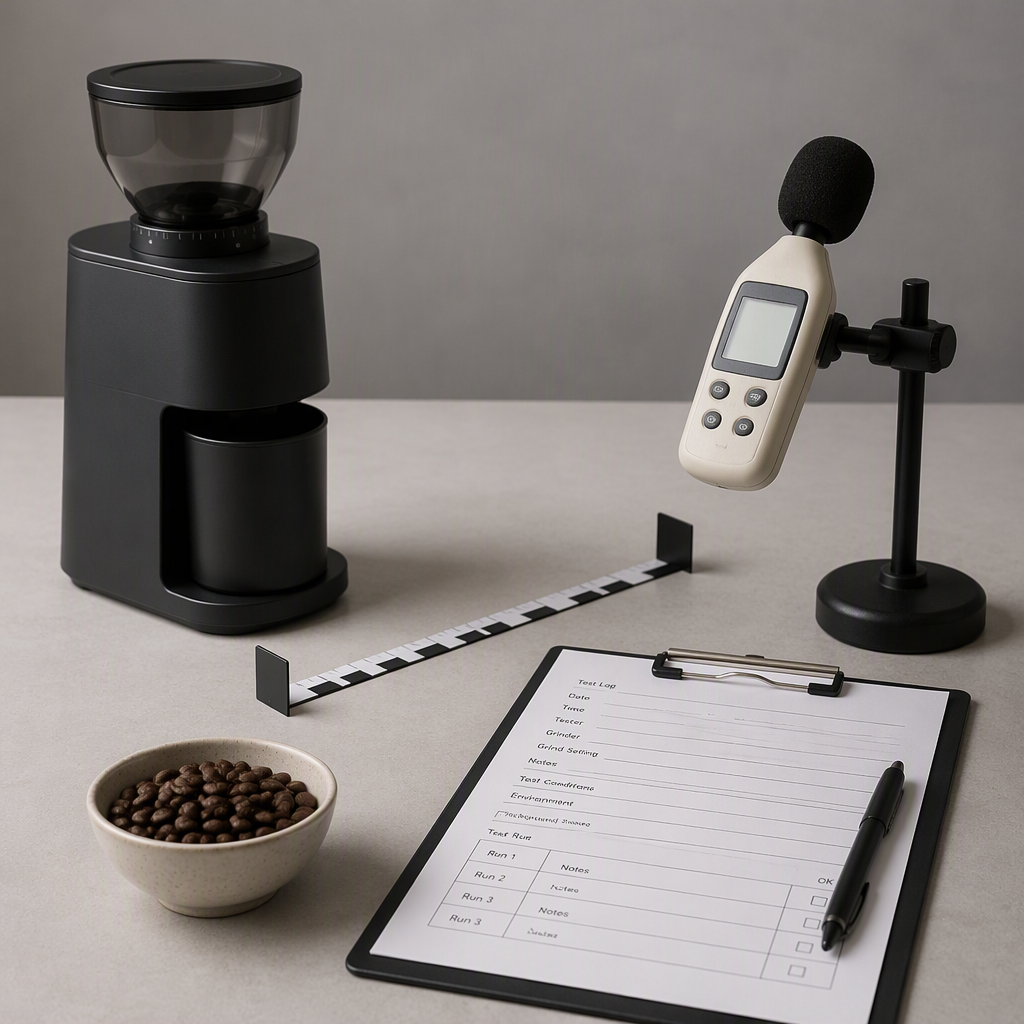
What coffee grinder noise level means in a buying comparison
A coffee grinder noise level is useful for procurement only when the reading is tied to how, where, and under what operating conditions the sound was measured.
Noise measurement guidance from the Canadian Centre for Occupational Health and Safety explains that sound pressure level may be measured with a sound level meter, integrating sound level meter, or dosimeter depending on the information needed. For grinder sourcing, that means a decibel value should not be treated as a complete product comparison unless the supplier also discloses the instrument type and measurement setup.
For a buyer comparing several grinder models, the practical question is not only “What dB?” but “What dB under which repeatable conditions?” A model tested in a quiet room with a documented setup and a model tested in an undefined showroom are not equivalent records.
Why distance and microphone position can change the comparison
Distance and microphone position should be written into every supplier noise record, because otherwise two coffee grinder noise level claims may describe different tests rather than different grinders.
Comparable record
The supplier states the microphone location, distance from the grinder, operating condition, meter type, and meter settings, so the buyer can repeat or compare the method.
Weak record
The supplier gives only a decibel number or a phrase such as “low noise,” with no measurement position or instrument detail to explain how the reading was obtained.
How to account for background noise before comparing dB values
Measure the room with the grinder off and then with the grinder running; if the source-on and source-off readings are more than 10 dB apart, CCOHS guidance says no background correction is needed.
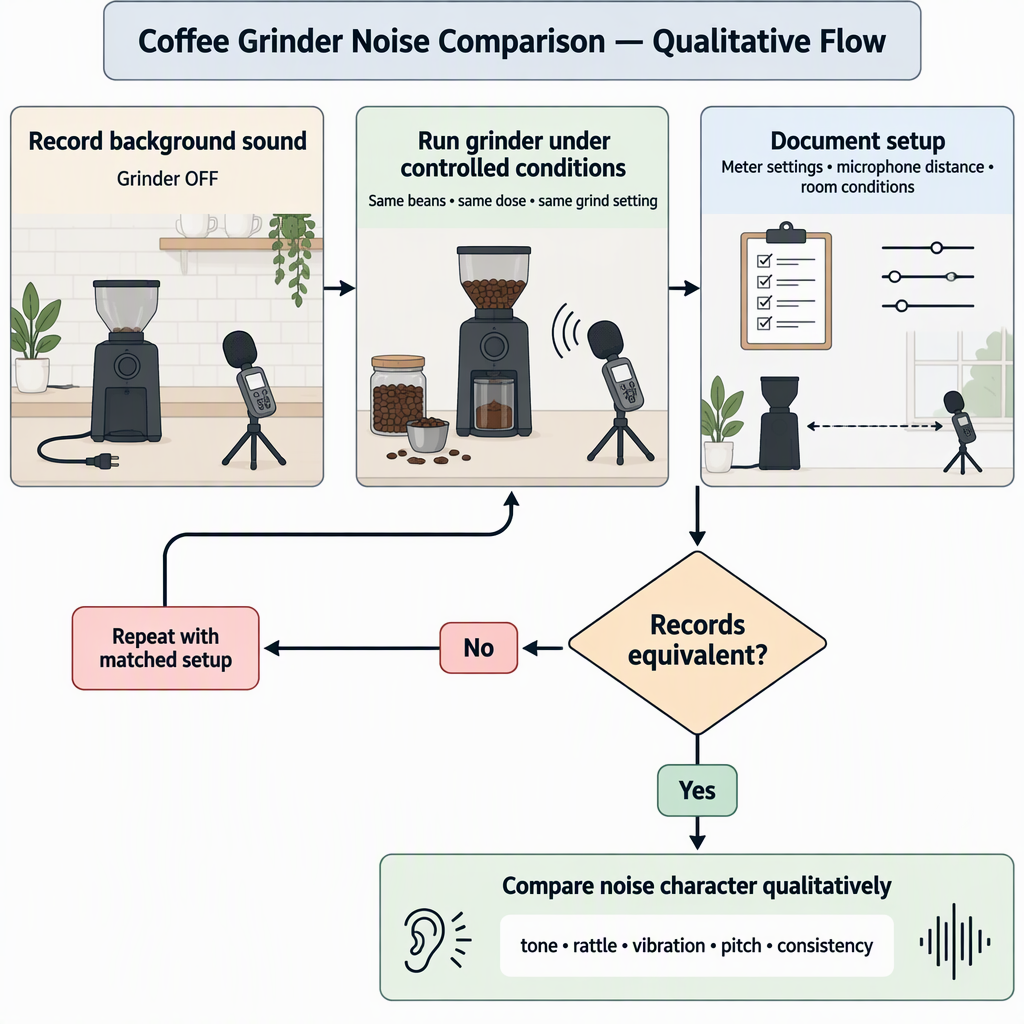
- Record the background sound with the grinder off, using the same location planned for the grinder test.
- Run the grinder under the agreed bean, dose, and grind-setting conditions, and record the sound level with the source on.
- Compare source-on and source-off readings; when the difference is more than 10 dB, the background influence does not require correction under the cited guidance.
- Keep the background reading in the supplier file even when no correction is needed, because it shows whether the test environment was controlled.
Measurement protocol buyers should request from suppliers
Ask each supplier for a short measurement protocol, not just a noise number, so your team can compare the same metric under the same conditions.
| Protocol item | What to request | Why it affects comparison |
|---|---|---|
| Instrument type | Sound level meter, integrating sound level meter, or other stated instrument | Different instruments answer different measurement questions. |
| Calibration | Confirmation that the meter was calibrated before and after use | Calibration supports confidence that the reading came from a controlled measurement process. |
| Weighting and response | A-weighting and slow response, when these are the agreed comparison settings | CCOHS notes that workplace measurements commonly use A-weighting and slow response. |
| Background reading | Source-off and source-on readings | The difference helps judge whether background sound influenced the reading. |
- Ask for the distance and position of the microphone.
- Ask whether the grinder was empty, loaded, grinding, or idling during measurement.
- Ask for the room condition and background level.
Bean type, roast, dose, and grind setting: conditions to control
For a fair grinder comparison, keep coffee variables consistent and record them as test conditions rather than assuming that a bare decibel value explains the whole result.
| Condition | What to standardize | How to use it in sourcing |
|---|---|---|
| Bean type and roast | Use the same coffee lot or clearly identify the coffee used. | Treat readings from different coffee inputs as separate test records. |
| Dose | Use the same dose per run. | Ask suppliers to state whether the reading came from a loaded grinding run. |
| Grind setting | Use the same intended brew setting category. | Compare records only when the operating condition is documented. |
| Run state | Separate idle, start-up, and active grinding records. | Do not compare an idle reading from one model with an active grinding reading from another. |
Where SCA standards fit—and where they do not
SCA standards can provide coffee-industry context, but the public standards page does not prove any grinder supplier’s certification or disclose the full SCA-320 test method.
The Specialty Coffee Association standards page describes SCA standards as a shared framework for quality, consistency, best practices, technical guidance, shared terminology, and equipment or brewing performance. It also lists SCA-320 Home Coffee Grinders: Specifications and Test Methods as a certification standard available through member or login access.
Supplier comparison checklist for quiet-grinder claims
Before accepting a quiet-grinder claim, procurement teams should require comparable test records and separate verified measurements from marketing language.
| Supplier claim | Buyer response | Accept as comparable? |
|---|---|---|
| “Low noise” | Request the measured sound level, instrument type, distance, background reading, and operating condition. | No, not until documented. |
| “Measured in our lab” | Ask whether the meter was calibrated before and after use and which weighting and response settings were used. | Possibly, if the method is disclosed. |
| “Designed to meet coffee standards” | Ask which standard, which edition or program, and whether a certificate or test report is available. | Only if the claim is documented. |
| “Quieter than competing models” | Ask for the full comparison protocol and confirm that all models were tested under the same conditions. | No, unless the comparison method matches. |
- Require one template for every supplier’s noise record.
- Keep background sound, meter settings, and grinder operating state in the comparison sheet.
- Do not treat standards language as certification unless the supplier provides direct proof.
- Shortlist models on comparable records, then evaluate other sourcing criteria such as product fit, documentation, and commercial terms separately.
Which noise metric should a buyer compare?
Buyers should first choose the metric that matches the decision: a simple sound level meter reading may describe a moment, while an integrating measurement can describe sound over a selected period.
| Decision need | Useful request | Buyer caution |
|---|---|---|
| Point-in-time comparison | Ask for the sound level meter reading and the exact operating state. | A single value may not represent the full grinding cycle. |
| Cycle comparison | Ask whether an integrating sound level meter was used and over what measurement period. | Compare only records with the same period and conditions. |
| Internal acceptance testing | Define the instrument, calibration, weighting, response, background check, and run state in the purchase file. | Do not mix supplier-provided values with store-demo observations without labeling the difference. |
Conclusion
A fair coffee grinder noise comparison is a controlled record, not a race to the lowest standalone dB figure.
- Normalize distance, meter settings, calibration, background noise, and operating condition before ranking grinder claims.
- Control bean, dose, and grind-setting variables instead of estimating corrections.
- Use SCA standards as coffee-industry context, but require direct proof for any certification claim.
FAQs about coffee grinder noise level comparisons
These questions help buyers turn noise claims into comparable supplier records.
What is a good coffee grinder noise level?
A “good” level depends on the use case and the measurement method. For sourcing, ask first whether the decibel value was measured with a documented instrument, position, background reading, and operating condition.
Can I compare dB values found on different supplier pages?
Only with caution. If the pages do not disclose the same distance, meter settings, background condition, and grinder run state, the numbers may not be like-for-like.
How much background noise is acceptable?
CCOHS guidance says background influence can be checked by measuring with the source on and off, and that no correction is needed when the difference is more than 10 dB.
Should buyers ask for A-weighting and slow response?
Yes, when those are the agreed comparison settings. CCOHS notes that workplace measurements commonly use A-weighting and slow response, so suppliers should disclose whether those settings were used.
Does SCA-320 prove a grinder is quiet?
The public SCA standards page lists SCA-320 as a home coffee grinder specification and test-method certification standard, but the detailed standard is access-restricted. Do not treat that listing as proof of any model’s noise performance or certification.
Do beans and grind settings need to match during testing?
Yes. They should be controlled and documented as operating conditions so the buyer compares equivalent records rather than different test situations.
Can a buyer name the quietest model from supplier claims alone?
Not reliably. A quietest-model ranking requires comparable measurements taken under the same protocol; unsupported marketing claims should stay outside the ranking.